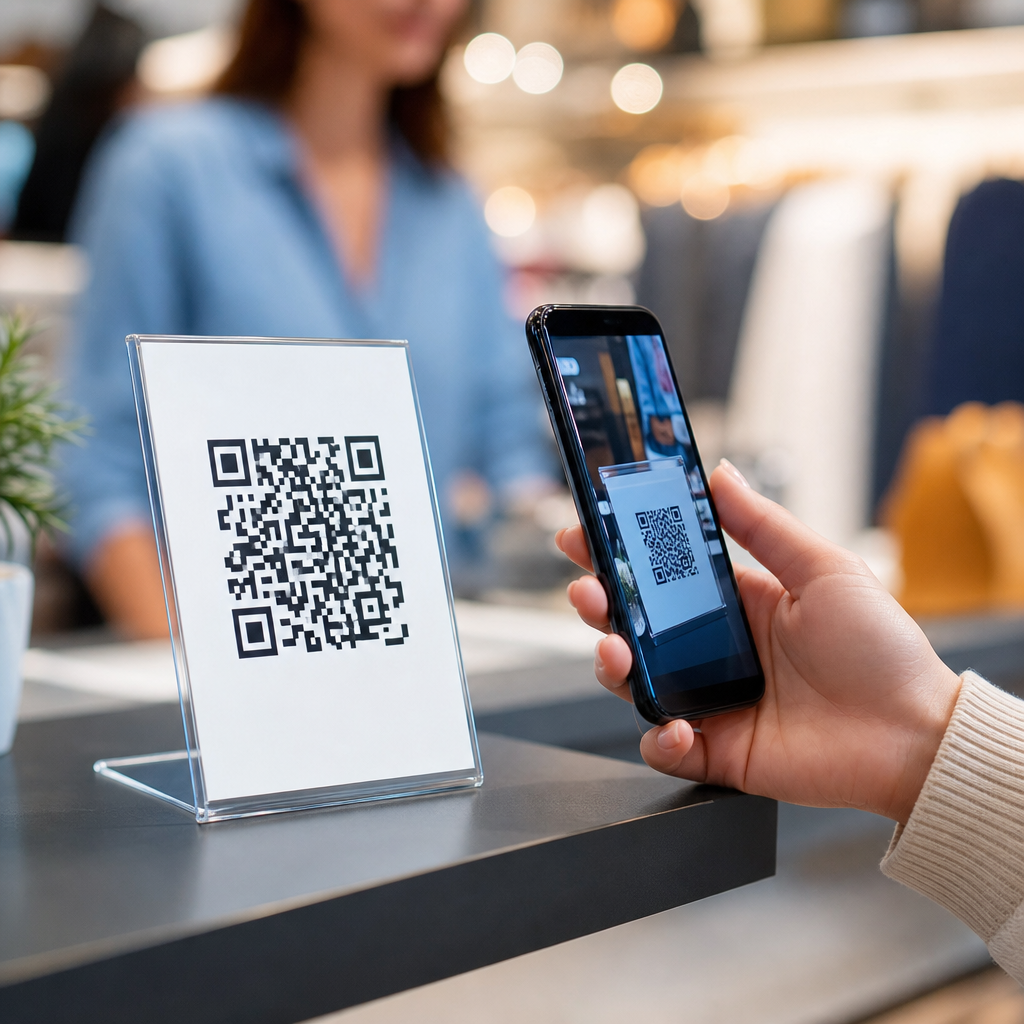
QR codes for in-store promotions have moved from novelty to core retail infrastructure because they connect physical shelves, packaging, windows, receipts, and point-of-sale displays to digital experiences customers can access in seconds. In retail and e-commerce, a QR code is a scannable matrix barcode that opens a landing page, activates a coupon, starts a loyalty enrollment, reveals product details, or routes a shopper into an app flow without typing a URL. I have implemented these campaigns across apparel, grocery, electronics, and pop-up retail, and the difference between a gimmick and a revenue driver is almost always execution: clear value, fast mobile pages, measurable tracking, and placement that matches shopping behavior. This matters because store traffic is expensive, promotional clutter is intense, and shoppers now expect the same depth of information in aisles that they get online. When used correctly, QR codes reduce friction between attention and action, helping retailers capture first-party data, improve merchandising, support omnichannel journeys, and measure offline-to-online attribution with far more precision than print signage alone ever allowed.
How QR Codes Support Retail and E-Commerce Growth
For retail and e-commerce teams, the strongest use of QR codes is not simply “linking to a website.” It is creating a measurable bridge between physical intent and digital conversion. A code on an endcap can open a product comparison page; a code on packaging can trigger reorders; a fitting-room sign can launch size availability across nearby stores; a checkout receipt can invite a review or loyalty sign-up. Each of these actions extends the store visit instead of ending it at the register. In practice, I have seen the highest scan rates when the benefit is stated plainly beside the code: “Scan for 15% off today,” “Scan to see ingredients,” or “Scan to check stock in your size.” Ambiguity depresses participation.
Retailers also use QR codes to unify store and online merchandising. A furniture chain can display one showroom sample while using a code to reveal every fabric, finish, and delivery timeline. A beauty retailer can link shelf talkers to ingredient explainers, tutorials, and shade-matching tools. Grocery stores can connect local produce displays to grower stories and recipe bundles that raise basket size. In e-commerce operations, the same codes appear in inserts, direct mail, and pickup counters to push app installs, subscription replenishment, and post-purchase education. The commercial value comes from continuity: one code, one message, one mobile destination, and one analytics trail tied to a campaign goal.
Best In-Store Promotion Types for QR Codes
Not every promotion deserves a QR code. The best candidates are offers that benefit from immediacy, personalization, or additional context. Time-sensitive discounts work well because scanning feels like unlocking something current and exclusive. “Scan for today’s weekend offer” performs better than a generic homepage link because shoppers understand why they should act now. Loyalty enrollment is another strong use case, especially when the mobile form is short and the reward is immediate, such as bonus points at checkout. Product education campaigns also perform well in categories where customers need reassurance before purchase, including consumer electronics, skincare, wine, and baby products.
Seasonal campaigns are particularly effective because QR placements can be updated dynamically without replacing all printed materials if retailers use editable codes. During back-to-school, a code on a backpack display can open curated bundles by age and budget. During holiday gifting, a jewelry store can use codes to show gift guides, engraving options, and in-stock pickup windows. Retail media teams increasingly attach QR codes to brand-funded displays so suppliers can measure engagement beyond the shelf. This is useful in co-op marketing because scan data can be segmented by store, region, or creative version, allowing retailers and brands to evaluate which displays actually moved shoppers from browsing to buying.
Placement, Design, and Mobile Experience That Increase Scans
Successful QR code placement follows customer movement, sightlines, and decision moments. At store entry, codes should support broad actions such as joining a loyalty program or opening a weekly circular. In aisles, they should answer product questions or activate category-specific offers. At checkout, they should simplify future engagement through app downloads, care instructions, or reorder prompts. Eye-level positioning generally outperforms floor decals unless the environment naturally directs shoppers downward, such as queue lines. The code itself must have strong contrast, quiet space, and a clear call to action. Tiny codes, reflective materials, or crowded graphics create scan failure and erode trust quickly.
The landing experience matters as much as the printed asset. Retail shoppers are often on cellular connections inside buildings, so pages must load fast, avoid heavy scripts, and present the promised value immediately above the fold. I recommend campaign-specific mobile pages rather than dumping users onto a general category page. If the sign says “scan for assembly video,” the first screen should be the video, not a menu. If the code offers a discount, the coupon should appear instantly with redemption instructions. Mobile usability standards from Google’s Core Web Vitals and accessibility basics such as readable fonts, tap-friendly buttons, and descriptive labels directly affect conversion because they reduce abandonment in the first seconds after the scan.
Measurement, Attribution, and Campaign Optimization
Retailers often ask how to measure QR code performance beyond raw scans. The answer is to define the full funnel before printing anything. At minimum, track scans, unique visitors, engagement rate, conversion rate, redemption rate, revenue per scan, and assisted outcomes such as email capture or store locator use. UTM parameters remain essential for campaign naming and source consistency in analytics platforms such as Google Analytics 4 or Adobe Analytics. For app flows, use deferred deep links and mobile measurement partners when needed. Dynamic QR platforms also allow device, time, and location reporting, which is valuable for comparing stores, endcaps, and promotional windows.
| Promotion goal | Best QR destination | Primary KPI | Common optimization lever |
|---|---|---|---|
| Drive immediate sales | Mobile coupon or flash offer page | Redemption rate | Clearer incentive and shorter redemption steps |
| Increase basket size | Bundle recommendation page | Average order value | Cross-sell relevance by category |
| Grow loyalty membership | One-page sign-up form | Completed enrollments | Fewer form fields and instant reward |
| Support product education | FAQ, demo video, or comparison page | Engaged visits | Stronger shelf messaging and faster page load |
| Enable replenishment | Reorder or subscribe page | Repeat purchase rate | Prefilled carts and saved preferences |
Optimization should be continuous, not annual. In one apparel campaign, moving a code from the bottom corner of a mirror cling to eye level near the fitting-room hook nearly doubled scans because customers noticed it while evaluating fit. In a grocery pilot, changing the CTA from “learn more” to “scan for tonight’s recipe” significantly increased engagement because it connected the code to an immediate meal decision. These are practical merchandising lessons, not abstract theory. Scan behavior is highly sensitive to message clarity, context, and reward, so A/B testing creative, destination pages, and placement should be part of normal retail operations.
Operational Best Practices, Compliance, and Common Mistakes
The operational side of QR code campaigns determines whether a program scales cleanly across stores and channels. Use dynamic codes when possible so destinations can be updated without reprinting displays, especially for seasonal promotions, inventory-driven offers, and franchise environments. Maintain a naming convention for every asset by store, fixture type, product line, and campaign date. Coordinate with merchandising, e-commerce, CRM, legal, and store operations before launch so coupon rules, inventory assumptions, and staffing are aligned. If a code drives buy online, pick up in store, stock feeds must be accurate. Nothing damages trust faster than scanning an offer that points to an unavailable item.
Security and compliance also matter. Branded domains improve trust and reduce the risk that customers mistake a legitimate code for a malicious redirect. Privacy notices should be accessible when collecting email addresses, location data, or loyalty enrollments. If promotions target regulated categories such as alcohol, supplements, or financial products sold in retail settings, age gates and disclosure requirements may apply. Common mistakes include linking to non-mobile pages, failing to state the benefit, printing codes too small, placing them where signals are weak, and neglecting staff training. Store associates should know what each major code does so they can prompt usage confidently. In the best retail and e-commerce programs, QR codes are treated as conversion assets, not decorative add-ons.
QR codes for in-store promotions work best when retailers treat them as part of a broader retail and e-commerce strategy rather than a one-off tactic. They help shoppers move from shelf to screen, from consideration to purchase, and from anonymous visit to measurable customer relationship. The strongest programs pair a visible incentive with thoughtful placement, fast mobile destinations, reliable analytics, and disciplined store execution. They also recognize limits: not every shopper will scan, weak connectivity can hurt performance, and poor inventory data can undermine otherwise strong creative. Even with those constraints, QR codes remain one of the most efficient tools for connecting physical commerce to digital convenience.
As the hub for retail and e-commerce applications, this topic leads naturally into deeper articles on loyalty QR codes, product packaging journeys, buy online pick up in store flows, retail media measurement, and post-purchase retention. The central lesson is simple: make the value obvious, remove friction after the scan, and measure every step. Retailers that do this well create promotions that are easier to launch, easier to optimize, and easier for customers to use. Review your current signage, receipts, packaging, and endcaps, identify one high-intent customer moment, and test a QR promotion built around that exact need.
Frequently Asked Questions
1. How are QR codes used effectively for in-store promotions?
QR codes work best in-store when they act as a fast bridge between a physical retail moment and a useful digital action. In practice, that means placing codes on shelves, endcaps, packaging, window displays, receipts, point-of-sale signage, fitting rooms, and countertop displays where customer intent is already high. Instead of asking shoppers to remember a website or search for a product later, the code lets them immediately open a coupon, claim a limited-time offer, view product details, compare variants, join a loyalty program, read reviews, or launch an app-based experience in seconds.
The most effective campaigns are built around a clear customer benefit. A shopper is much more likely to scan when the signage explains exactly what happens next, such as “Scan for 15% off,” “Scan to see ingredients and reviews,” or “Scan to join rewards instantly.” Strong execution also depends on simple landing experiences. If the QR code opens a confusing page, requires too many clicks, or fails to load properly on mobile, performance drops quickly. The entire flow should feel frictionless, mobile-first, and consistent with the in-store message.
Retailers also see better results when QR codes are tied to specific promotional objectives rather than used as a generic add-on. For example, one code might drive trial of a new product, another might help move overstock with an instant digital coupon, and another might support omnichannel shopping by linking to size availability or alternate colors online. When each code has a defined purpose and measurable outcome, in-store promotions become easier to optimize and scale.
2. What types of offers and customer experiences perform best with QR codes in retail stores?
High-performing QR code promotions typically offer immediate relevance, convenience, or savings. Digital coupons are one of the strongest use cases because they create an instant incentive to scan and can be redeemed on the spot. Shoppers also respond well to loyalty enrollment offers, “scan to save” promotions, limited-time bundles, instant rebates, sweepstakes entries, and exclusive product education that helps them make a purchase decision. In categories where comparison matters, QR codes that unlock specifications, how-to content, tutorials, compatibility details, or customer reviews can be especially effective.
Product-specific experiences often outperform broad, generic destinations because they align with what the customer is already looking at. A code on packaging can reveal sourcing details, ingredients, care instructions, or usage tips. A shelf tag can connect shoppers to color options, inventory availability, or personalized recommendations. A storefront code can promote after-hours browsing, app downloads, or click-and-collect services. A receipt code can encourage repeat visits with bounce-back offers or simplify post-purchase registration and rewards enrollment.
The best results usually come from matching the promotion to shopper intent at that exact location in the store. Near the entrance, the goal may be traffic and awareness. At the shelf, the goal may be conversion. At checkout, the goal may be loyalty or repeat purchase. When QR code experiences are designed around those moments, they feel useful rather than gimmicky, and customers are more likely to engage.
3. What are the most important best practices for creating QR code campaigns that actually get scanned?
Successful QR code campaigns depend on visibility, clarity, trust, and ease of use. First, the code must be placed where shoppers can comfortably notice and scan it. That means avoiding awkward angles, tiny print sizes, reflective surfaces, poor lighting, or placements that force customers to stand too far away. The code should have enough contrast, adequate white space, and a size appropriate for the scanning distance. If the environment is busy, the call to action needs to stand out immediately.
Second, every QR code should be paired with direct language that answers the customer’s unspoken question: “Why should I scan this?” Specific calls to action consistently perform better than vague instructions. “Scan to get today’s coupon” or “Scan to compare flavors” is much stronger than simply “Scan here.” It is also smart to include brand cues nearby so shoppers know the code is legitimate and safe to use. Trust matters, especially when customers are cautious about unknown links.
Third, the mobile destination must be fast, relevant, and easy to complete. The landing page should load quickly, display well on all screen sizes, and minimize unnecessary steps. If the scan is connected to a promotion, shoppers should not have to hunt for the discount once they arrive. If the goal is loyalty enrollment, the form should be short and the value proposition clear. If the experience requires an app, provide a fallback web path so the promotion still works for non-app users. Testing is essential across devices, browsers, operating systems, lighting conditions, and store environments before full rollout.
Finally, use trackable and preferably dynamic QR codes so the destination can be updated without reprinting signage. This allows retailers to change offers, fix issues, run A/B tests, and monitor scan performance by store, placement, campaign, or product category. That flexibility turns QR codes from static print elements into measurable, optimizable retail media assets.
4. How can businesses measure the success of QR codes for in-store promotions?
Measuring QR code performance starts with defining the goal of the promotion before the code is deployed. A campaign designed to drive coupon redemptions should be evaluated differently from one meant to increase loyalty signups, educate customers, or move traffic into an app journey. Core metrics usually include scans, unique scans, scan-through rate relative to foot traffic or impressions, landing page engagement, coupon activations, redemptions, enrollments, assisted conversions, and repeat visits. For some retailers, the most valuable metric is not the scan itself but the downstream action it produces.
To get clean data, it is important to assign separate QR codes or tracking parameters to different placements, stores, product lines, or promotional messages. That makes it possible to compare performance at a much more practical level. For example, a shelf-edge code may generate more conversions than a window display code, while a “save now” message may outperform a “learn more” message. Those insights help retailers improve both creative execution and media allocation inside the store.
Measurement should also connect online interactions to offline business outcomes whenever possible. If a customer scans a code, activates an offer, and redeems it at checkout, that full journey should be visible in reporting. The same is true for loyalty joins, app installs, and product page visits that later result in purchases. Retailers with stronger analytics setups can go further by comparing store-level lift, average order value, basket attachment, or repeat purchase behavior among customers exposed to QR promotions versus those who were not.
In short, the most meaningful evaluation framework looks beyond vanity metrics. A high scan count is useful, but what matters most is whether the QR code improved conversion, increased customer value, supported omnichannel behavior, or made the in-store experience easier and more persuasive.
5. Are QR codes for in-store promotions still worth investing in, and what mistakes should retailers avoid?
Yes, QR codes are absolutely worth investing in when they are treated as part of retail infrastructure rather than as a one-off tactic. Their value comes from how efficiently they connect physical touchpoints to digital actions without requiring downloads, manual typing, or staff intervention. For retailers and e-commerce brands operating in physical spaces, that makes QR codes a practical tool for promotions, product discovery, loyalty growth, post-purchase engagement, and omnichannel conversion. They are relatively inexpensive to deploy, easy to update when dynamic, and highly adaptable across stores, packaging, displays, and receipts.
That said, poor execution is still common. One major mistake is using QR codes without a meaningful value exchange. If scanning leads to a generic homepage or content the shopper could have found more easily another way, engagement suffers. Another common error is overcomplicating the experience with long forms, multiple redirects, slow-loading pages, or app-only dead ends. In-store shoppers tend to make quick decisions, so every extra step reduces performance.
Retailers should also avoid inconsistent branding, unclear calls to action, and lack of testing. A code that is hard to scan or placed in a low-visibility location will underperform no matter how strong the offer is. Security perception matters too. Customers are more comfortable scanning when the surrounding signage clearly identifies the brand and explains the destination. Finally, many businesses make the strategic mistake of launching QR promotions without a measurement plan, which makes it difficult to prove ROI or improve future campaigns.
When implemented thoughtfully, QR codes are no longer a novelty. They are a scalable, measurable way to turn shelves, signage, packaging, and receipts into active digital conversion points. For retailers that want to create faster customer journeys and stronger connections between store traffic and digital engagement, they remain one of the most practical promotional tools available.