QR codes for hotel check-ins in travel have moved from a convenience feature to a core part of modern guest operations. In practical terms, a QR code is a scannable matrix barcode that opens a digital action, such as an online registration form, mobile key setup, payment page, welcome guide, or identity verification flow. A hotel check-in is the set of steps that confirms a reservation, verifies the guest, assigns a room, and grants access. When those steps are linked through QR codes, hotels reduce front-desk queues, speed up arrivals, and create a cleaner handoff between booking, arrival, room access, and guest communication.
This matters across travel and tourism because arrival is the highest-friction moment in the guest journey. I have helped operators deploy QR-driven arrival flows in city hotels, resort properties, and serviced apartments, and the pattern is consistent: guests want less waiting, staff want fewer repetitive tasks, and management wants measurable gains in throughput, upsell conversion, and service quality. The rise of mobile-first travel planning, online travel agencies, contactless expectations after the pandemic, and tighter labor markets have all pushed hotels to redesign check-in. QR codes sit at the center of that redesign because they are inexpensive to deploy, easy to scan on nearly any smartphone, and flexible enough to connect with property management systems, digital identity tools, payment gateways, and mobile key platforms.
For a travel and tourism business, the value is broader than operational speed. A QR code can trigger multilingual instructions for international visitors, support self-service for late arrivals, guide guests to airport transfer details, and link to local destination content. That makes this topic a hub for the wider travel segment: hotels, hostels, vacation rentals, cruise embarkation desks, airport lounges, tour operators, and attractions all use the same basic logic. The essential question is not whether QR codes are useful, but how to implement them in a way that is secure, compliant, and genuinely better for guests.
How QR code hotel check-ins work in travel operations
A typical QR code hotel check-in flow starts before arrival. After booking, the guest receives a confirmation email, app notification, or messaging link containing a dynamic QR code. Scanning it opens a secure landing page tied to the reservation. On that page, the guest reviews booking details, enters estimated arrival time, submits identification where permitted by local law, signs registration terms, adds payment details, and accepts optional upgrades. When the room is ready, the same flow can deliver a second QR code for kiosk check-in or activate a mobile key in systems such as ASSA ABLOY OpenKey, SALTO KS, or dormakaba-compatible platforms.
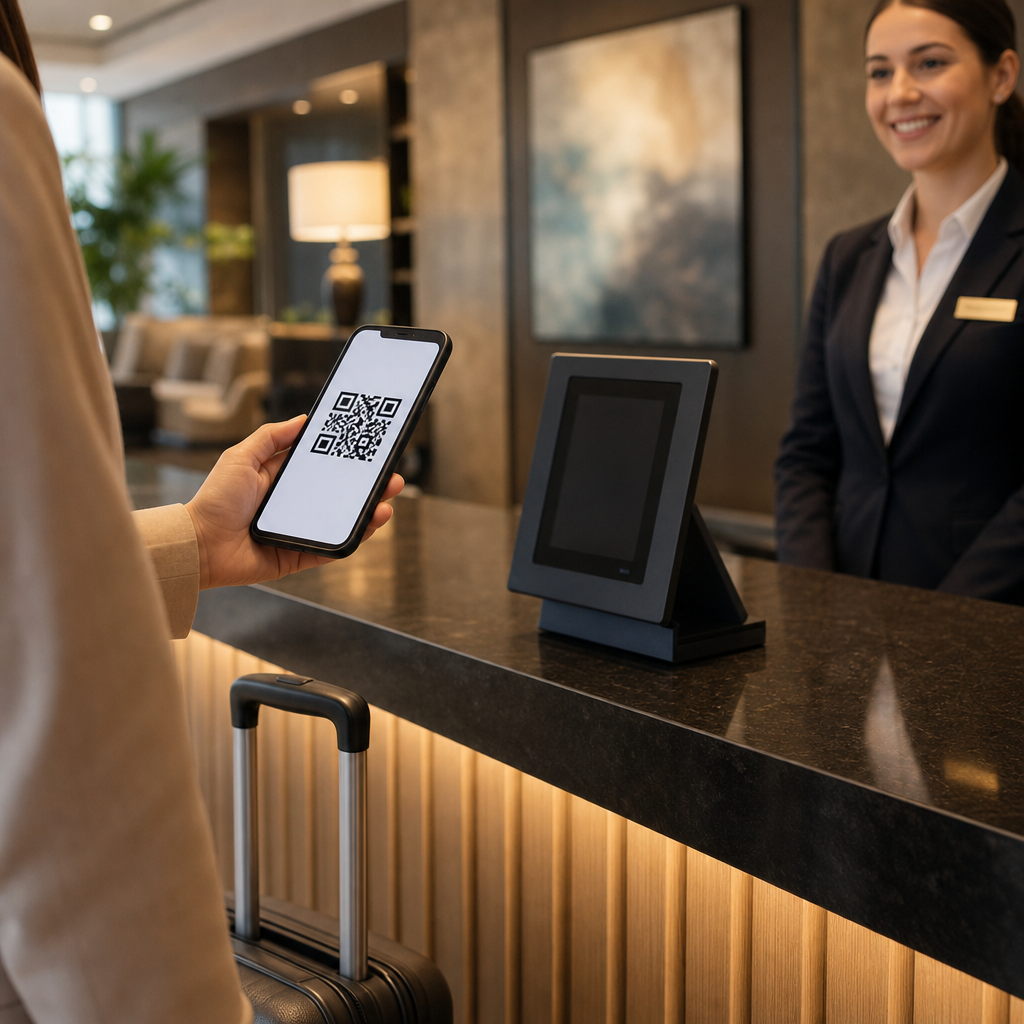
At the property, the code can support several models. In a staffed hotel, it lets front-desk agents pull up the reservation instantly instead of searching by name or confirmation number. In a semi-automated setup, the guest scans at a lobby kiosk, verifies identity, and receives a room assignment and key card. In a fully contactless model, the guest completes all steps remotely and bypasses the desk entirely. This is especially useful for airport hotels handling late-night arrivals, ski lodges with peak check-in surges, and aparthotels where one employee may supervise multiple properties.
The operational backbone usually includes a property management system such as Oracle OPERA Cloud, Mews, Cloudbeds, RMS, or Maestro, plus integrations for payments and digital locks. Dynamic QR codes are preferable to static codes because they can be updated without reprinting and can track scan events by source, device, time, and location. That data helps revenue and operations teams understand where guests complete pre-check-in, where they abandon the flow, and which campaigns produce faster arrivals.
Benefits for hotels, guests, and the wider tourism ecosystem
The most immediate benefit is shorter wait time. When guests complete registration and payment steps before arrival, front-desk interaction drops from several minutes to seconds. In busy urban hotels serving conference groups or red-eye arrivals, that directly improves lobby flow. It also reduces line anxiety, which affects satisfaction disproportionately because first impressions shape the entire stay. Hotels often measure this through average check-in time, queue length at peak hours, percentage of pre-arrival registration completed, and guest satisfaction scores tied to arrival.
QR code check-ins also improve labor efficiency. Staff spend less time copying passport details, reissuing forms, or answering repetitive logistical questions. That frees them for higher-value work such as resolving booking issues, coordinating special requests, and recommending local experiences. In tourism markets where staffing is tight, this matters as much as cost reduction. A lean team can handle higher occupancy without degrading service standards.
For guests, the benefit is control. Travelers arriving from long flights can check in from a taxi, submit a deposit from their phone, and head straight to the room. International visitors can view translated instructions, Wi-Fi details, breakfast times, and transport guidance without waiting at the desk. Families appreciate being able to complete forms while one parent manages luggage and children. Business travelers value the predictability, especially when they need a quick turnaround before meetings.
The ecosystem effect is often overlooked. A QR check-in page can route guests to destination-specific services such as spa reservations, airport shuttle scheduling, city attraction passes, restaurant booking, loyalty enrollment, and post-stay review requests. In that sense, the arrival flow becomes a travel commerce touchpoint rather than a narrow administrative task.
Best use cases across travel and tourism
Hotels are the obvious use case, but the strongest implementations align with property type and guest behavior. Boutique city hotels use QR pre-check-in to preserve a premium feel while minimizing desk bottlenecks in small lobbies. Large convention hotels use it to absorb sudden waves of arrivals tied to event schedules. Resorts use it to collect preferences for dining times, kids club consent, and activity waivers before guests reach the property. Extended-stay and serviced apartment brands use QR flows to manage remote arrivals, parking access, and digital house manuals.
Adjacent sectors can apply the same logic. Hostels can pair QR codes with bunk assignment and policy acknowledgment. Vacation rentals can send a QR code for guest verification, security deposit collection, and property access instructions. Cruise terminals can use QR-driven embarkation forms to streamline boarding windows. Tour operators can connect hotel arrival communications with itinerary updates and transfer pickup details. In every case, the principle is identical: move routine verification and orientation tasks off the queue and onto the guest’s device.
| Travel segment | Primary QR check-in use | Guest benefit | Operational gain |
|---|---|---|---|
| City hotel | Pre-arrival registration and payment | Faster arrival after flights or rail trips | Shorter lobby queues |
| Resort | Preferences, waivers, upsells | Personalized stay setup | Higher ancillary revenue |
| Serviced apartment | Remote identity check and access guide | Late self-service arrival | Lower staffing demand |
| Hostel | Policy acceptance and bed assignment | Quicker onboarding for groups | Less manual paperwork |
| Cruise terminal | Embarkation forms and time slots | Smoother boarding process | Better passenger flow |
Implementation, security, and compliance considerations
A successful deployment starts with process mapping. Hotels should document the current arrival journey, identify bottlenecks, and define which steps can legally and practically move online. Identity verification rules vary by country, as do registration requirements for foreign nationals, tax collection, and signature retention. Payment handling must follow PCI DSS requirements, and any personal data gathered during pre-check-in must be processed under applicable privacy laws such as GDPR or regional equivalents. A QR code strategy that ignores local compliance creates more risk than value.
Security design matters because travelers are familiar with malicious QR schemes in public spaces. Hotels should use branded landing pages, HTTPS, custom domains, and clear sender authentication in email or SMS. Dynamic QR codes should expire when appropriate and resolve only to secure pages controlled by the operator or trusted vendor. If the workflow includes identity document capture, hotels should define retention rules, access controls, and audit trails. If mobile keys are issued, the lock system and app permissions need review, especially for shared devices and revoked access scenarios.
Accessibility is another requirement, not a nice-to-have. The check-in page should be mobile responsive, lightweight on slow networks, and readable by screen readers. Guests must have a fallback option if their phone battery is dead, if roaming is unavailable, or if they prefer human service. The best operators do not force contactless; they make it the fastest option while preserving choice.
Common mistakes and what high-performing hotels do differently
The most common mistake is treating the QR code as the strategy instead of the entry point. A code that leads to a clumsy form, repeated data entry, or a page that is not integrated with the PMS simply shifts friction from the desk to the phone. I have seen hotels ask guests to fill out digital forms and then repeat the same information at arrival because the front desk could not retrieve it cleanly. That undermines trust immediately.
High-performing hotels design the full journey. They prefill reservation data, keep forms short, support digital wallets, offer multilingual content, and send reminders at the right time, typically twenty-four to forty-eight hours before arrival. They test the flow on iPhone and Android, over Wi-Fi and cellular, and in poor-signal conditions common in basements, remote resorts, and transit corridors. They train staff to recognize where guests get stuck and to recover gracefully without blame.
Another mistake is over-automation. Some properties remove too much human support and discover that complex cases, room changes, loyalty issues, and family bookings still require intervention. The better model is assisted self-service: automate the repetitive steps, then let staff focus on exceptions and hospitality. That balance protects brand experience while still delivering the efficiency gains that made QR code hotel check-ins attractive in the first place.
How to measure success and build the travel hub from here
Hotels should evaluate QR code check-ins using operational, financial, and guest-centered metrics. The core operational measures are pre-check-in completion rate, average arrival processing time, queue length at peak check-in windows, and percentage of guests who bypass the desk entirely. Financially, operators should track conversion on paid upgrades, early check-in fees, and ancillary bookings presented in the pre-arrival flow. Guest metrics include satisfaction with arrival, app adoption, and complaint rate related to access or identity verification.
For a broader travel and tourism content hub, this topic connects naturally to mobile keys, digital concierge services, airport and rail hospitality, vacation rental guest verification, event accommodation management, and multilingual traveler communications. Together, those subjects explain how QR codes support the entire guest journey, not just the handoff at the front desk. If you manage a travel business, audit your arrival process, identify one friction point, and pilot a QR-based check-in flow that solves it cleanly. The gains in speed, service, and scalability are real when the system is integrated, secure, and built around how travelers actually arrive.
Frequently Asked Questions
What are QR codes for hotel check-ins, and how do they work in practice?
QR codes for hotel check-ins are scannable codes that connect guests to the digital steps required to complete arrival without relying entirely on a front desk interaction. In a hotel setting, the code may open a pre-arrival registration form, a secure identity verification page, a digital payment screen, a room assignment workflow, a mobile key setup, or a welcome guide with property details. Instead of asking every guest to move through these steps manually at the desk, the hotel can send a QR code by email, text message, app notification, or display it on-site at kiosks, lobbies, parking areas, or self-service stations.
In practice, the flow is straightforward. A guest scans the QR code with a smartphone camera, taps the link, confirms reservation details, submits required information, and completes any outstanding tasks such as uploading identification, agreeing to policies, or authorizing a card for incidentals. Once those steps are finished, the property management system or connected guest experience platform can trigger the next action, such as marking the guest as checked in, issuing a mobile room key, notifying staff, or sending directions to the assigned room. This reduces friction, shortens lines, and creates a more flexible arrival experience for both the traveler and the hotel team.
Why are hotels increasingly using QR codes as part of the check-in process?
Hotels are adopting QR code check-ins because they improve speed, efficiency, and guest convenience while supporting more consistent operations. Modern travelers often prefer fast, mobile-first experiences, especially after a long flight, late-night arrival, or busy travel day. A QR code makes the check-in process easier to access because it removes the need to download a complicated app or wait for a staff member to manually enter information. One scan can take the guest directly to the exact action required, which helps reduce abandoned check-ins and confusion.
From an operational perspective, QR codes help hotels shift routine administrative tasks away from the front desk. Staff spend less time collecting repeated information and more time assisting guests with higher-value service needs. This can reduce congestion during peak arrival windows, improve labor efficiency, and lower the likelihood of manual entry errors. QR code workflows also support contact-light service models, multilingual digital instructions, easier upselling, and stronger integration with hotel systems such as property management software, payment gateways, digital key providers, and guest messaging platforms. In short, QR codes are becoming a core hotel check-in tool because they serve both guest expectations and operational performance.
Are QR code hotel check-ins secure for guest information and identity verification?
They can be very secure when implemented correctly. A QR code itself is simply a gateway that directs the guest to a digital destination, so the real security depends on the system behind it. Hotels should use encrypted web pages, secure payment processing, authenticated identity verification tools, time-sensitive or single-use links where appropriate, and tightly controlled integrations with their reservation and access systems. If the QR code leads to a branded, HTTPS-secured page and the workflow is connected to compliant software vendors, the process can be as secure as other trusted online transactions in travel and hospitality.
Best practices matter. Hotels should avoid printing static codes that expose sensitive functions without authentication, and they should make sure guests are asked to verify identity before receiving room access or completing key actions. Security is also improved when QR check-in pages are linked to reservation-specific data, protected with tokenized access, and monitored for fraud attempts. For travelers, it is wise to scan only codes sent through official hotel channels or displayed clearly on hotel property, and to confirm that the landing page matches the hotel’s legitimate branding and web domain. When these safeguards are in place, QR code check-ins can streamline arrival while maintaining strong standards for privacy, access control, and guest trust.
What are the main benefits of QR codes for hotel guests and hotel staff?
For guests, the biggest benefit is convenience. QR codes allow travelers to begin or complete check-in on their own schedule, whether they are in a taxi heading to the property, standing in the lobby, or arriving after the front desk is busy. This can mean faster registration, less paperwork, easier mobile payments, quicker access to room details, and immediate delivery of useful information like Wi-Fi instructions, breakfast hours, parking guidance, and amenity access. Guests also benefit from a more predictable experience because the digital flow can clearly guide them through each required step without long waits or inconsistent verbal explanations.
For hotel staff, QR codes create a more organized and scalable check-in operation. Teams can reduce repetitive tasks, cut down on lobby bottlenecks, and improve accuracy by collecting guest data directly through digital forms instead of handwritten cards or verbal transcription. QR-driven check-ins also make it easier to standardize policy acknowledgments, capture upsell opportunities such as room upgrades or add-on services, and keep records tied to the reservation in real time. Perhaps most importantly, staff gain more time to focus on hospitality rather than administration. Instead of spending every interaction on logistics, they can solve problems, personalize service, and improve the overall guest experience.
How can a hotel implement QR codes for check-ins effectively without creating confusion for travelers?
Successful implementation starts with a clear, guest-friendly workflow. Hotels should map the full arrival journey first, including pre-arrival communication, identity verification, payment authorization, room readiness, key issuance, and post-check-in messaging. The QR code should lead to a simple mobile-optimized page with clear instructions, minimal steps, and strong branding so guests immediately know they are in the right place. It is also important to decide where the codes will appear, such as booking confirmation emails, reminder texts, lobby signage, kiosks, parking entrances, or in-app messages. The goal is to place the code where it naturally supports the guest’s next action.
To avoid confusion, hotels should not treat QR codes as a standalone gimmick. They work best when supported by plain-language instructions, multilingual options where needed, fallback assistance from staff, and a system that integrates smoothly with core hotel technology. For example, if a guest completes digital registration through a QR code, the property management system should reflect that status immediately. If a mobile key is offered, the transition from verification to room access should be seamless. Hotels should also test the flow across different phone types, arrival scenarios, and connectivity conditions. When implementation is thoughtful, QR codes make hotel check-ins feel faster and more intuitive rather than more complicated.