QR codes for emergency contact information give healthcare organizations a fast, low-friction way to connect patients, caregivers, clinicians, and first responders when seconds matter. In practical terms, a QR code is a scannable image that opens digital content, while emergency contact information includes the names, phone numbers, relationships, and care instructions a responder may need during a medical event. In healthcare, these codes can appear on wristbands, ID cards, discharge packets, medication organizers, mobility devices, refrigerator magnets, or patient portals. I have helped clinics and care teams deploy similar systems, and the lesson is consistent: the value is not the code itself, but the reliability of the information behind it. When implemented well, QR codes reduce delays, support care coordination, and help staff verify who to call, what conditions matter, and which steps should come first.
This topic matters because healthcare communication often breaks down at handoffs. A patient may arrive unconscious, an older adult may live alone, a child may be with a school nurse rather than a parent, or a home health aide may not know the full medication history. Paper contacts are frequently outdated, buried in a wallet, or inaccessible after a fall. A QR code can bridge that gap by pointing to a controlled digital record that is easier to update than printed materials. It can also support multilingual instructions, accessibility features, and links to consent forms or advance directives. For healthcare leaders building safer workflows, QR codes are not a novelty. They are an information access tool that can strengthen emergency preparedness, especially across hospitals, outpatient clinics, senior living, rehabilitation, behavioral health, and home-based care.
To use them responsibly, healthcare teams need to define both scope and boundaries. A QR code for emergency contact information should answer immediate questions first: Who should be contacted? How quickly can they be reached? What health details are necessary for urgent care? That does not mean exposing an entire medical chart. In most cases, the safest design is a minimal emergency profile with controlled access to deeper records only when appropriate. This hub article focuses on healthcare because the operational details matter more here than in most industries. Regulations, privacy expectations, clinical liability, and patient safety all shape how these systems should be designed. The sections below explain where QR codes work best, what data to include, how to protect privacy, and how healthcare organizations can deploy them in a way staff will actually use.
How QR codes improve emergency response in healthcare settings
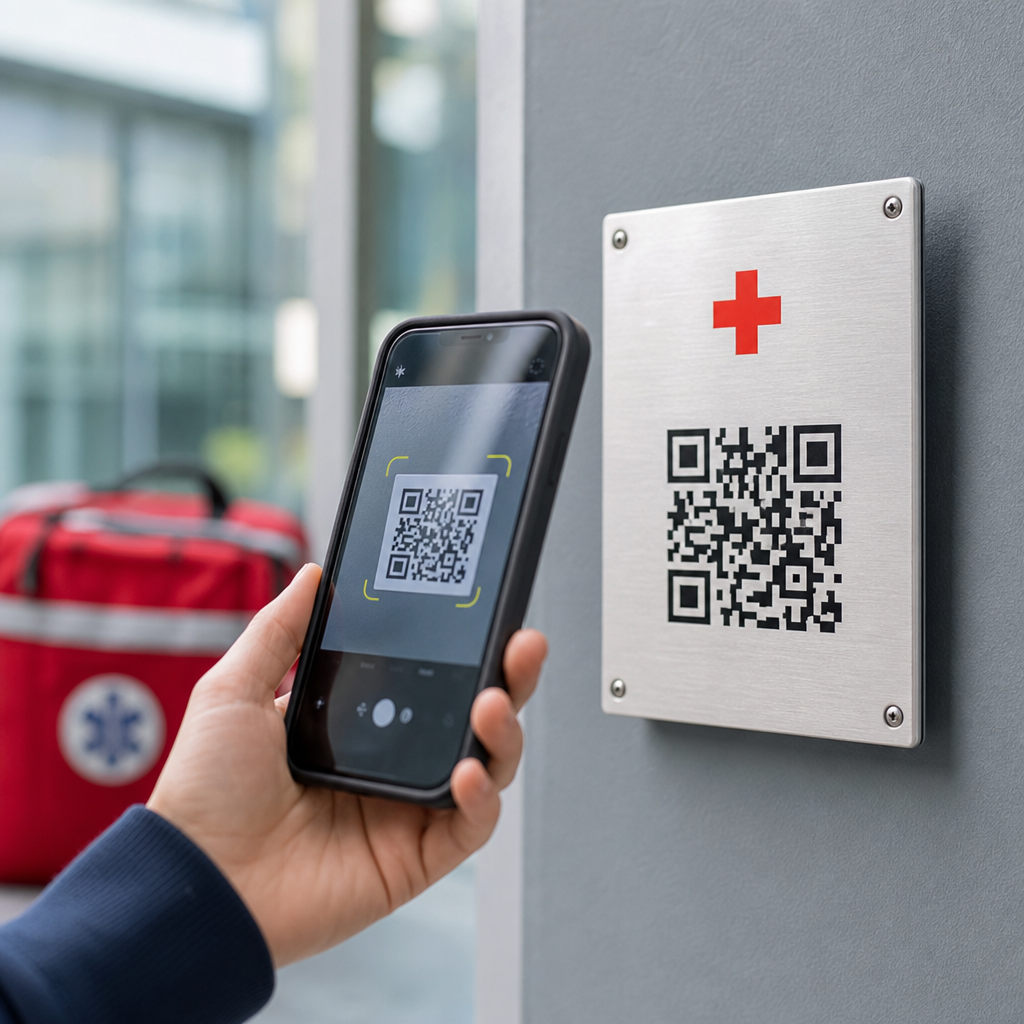
In healthcare, the strongest use case is reducing time spent searching for basic facts during an emergency. A responder scanning a code on a patient wristband, card, phone lock screen, or room notice can immediately see the emergency contact, preferred hospital, primary language, allergies, and critical conditions such as diabetes, epilepsy, anticoagulant use, or severe drug reactions. That speed matters because emergency care starts with triage and stabilization, not administrative intake. In my experience, teams are far more likely to trust and use a QR workflow when the landing page is short, mobile-friendly, and structured for rapid scanning by humans, not just devices.
Healthcare environments also involve repeated transitions, and QR codes help standardize communication across them. A patient discharged after surgery may receive a printed instruction sheet with a code linking to the latest care plan and caregiver contacts. If the patient returns to the emergency department with complications, staff can quickly confirm who is coordinating postoperative care. In home health, a code placed in a visible but discreet location can help paramedics contact family members and view resuscitation preferences. In long-term care, codes can support residents who have cognitive impairment, where confirming identity and family communication pathways is often difficult under pressure. The practical advantage is continuity: one update to the source record can support every printed code already in circulation.
Best healthcare use cases across hospitals, clinics, senior care, and home health
Hospitals use QR codes most effectively when they are tied to existing patient identity and communication workflows rather than treated as a standalone project. Common placements include emergency department wristbands, bedside cards, discharge folders, and patient portal summaries. For pediatric care, a code can link to parent or guardian contacts, consent notes, and pediatrician information. In oncology or dialysis units, where recurring visits are common, a scannable emergency profile can help unfamiliar staff identify time-sensitive considerations quickly. The same principle applies in behavioral health, where de-escalation contacts and crisis support instructions may be more relevant than broad medical detail.
Outpatient clinics and ambulatory surgery centers often use QR codes to support after-hours events. A patient who develops symptoms at home can share the code with urgent care staff or family members, reducing reliance on memory during stress. In senior living and skilled nursing, codes are especially useful for residents with dementia, fall risk, or multiple chronic conditions. Home health agencies can include them in welcome kits or care binders alongside medication lists and agency numbers. The code becomes a reliable access point for family caregivers, visiting nurses, and emergency medical services. The strongest deployments are simple, durable, and easy to find, without requiring an app download or complicated login for urgent, low-risk information.
| Healthcare setting | Typical QR code placement | Most useful emergency data | Primary benefit |
|---|---|---|---|
| Hospital inpatient unit | Wristband or bedside card | Emergency contact, allergies, language, critical diagnosis | Faster triage and family notification |
| Outpatient clinic | Visit summary or patient portal handout | Care team contacts, after-hours instructions, medication alerts | Better follow-up during complications |
| Senior living community | ID card or room packet | Family contacts, cognitive status, mobility needs, code status | Safer response during falls or confusion |
| Home health | Care binder or refrigerator magnet | Caregiver contacts, diagnoses, medication list, agency number | Continuity for paramedics and visiting staff |
What information to include and how to structure it clearly
The best emergency contact QR code pages follow a strict hierarchy. Start with the patient’s preferred name, date of birth, and a photo only if identity confusion is a real risk and consent is documented. Next list primary and secondary emergency contacts with relationship, phone number, and best time or method to reach them. Then include urgent clinical alerts: severe allergies, implanted devices, anticoagulants, seizure disorder, diabetes treatment, fall risk, or communication limitations. After that, add care coordination details such as primary care physician, specialist, pharmacy, insurer, and preferred hospital. Finally, provide document links for advance directives, guardianship papers, or care plans if policy permits.
Structure matters because responders do not read long paragraphs under pressure. Use labeled fields, timestamps, and clear update ownership. Every emergency profile should show when it was last verified and by whom, whether that is the patient, caregiver, registration team, or case manager. Avoid clutter such as full medication histories unless the setting truly requires them; instead link to a deeper record with appropriate protections. I recommend healthcare organizations create templates by population: pediatric, adult chronic care, memory care, post-acute rehabilitation, and home hospice. Standardized templates improve adoption because staff know where to find each element, and patients are more likely to keep the information current when the form is short and specific.
Privacy, security, consent, and regulatory considerations
Privacy is the central design challenge. In healthcare, emergency access must be balanced against the obligation to limit unnecessary disclosure. Public-facing QR codes should not expose sensitive diagnoses, full Social Security numbers, or broad clinical histories. A better model is tiered access: a basic emergency page for immediate response and a protected layer for authorized staff. Organizations should conduct a risk assessment, define a minimum necessary data set, and document consent language clearly. In the United States, teams generally evaluate these workflows under HIPAA privacy and security rules, while also considering state laws, minors’ consent rules, and long-term care documentation requirements.
Security controls should be proportionate to the data and context. At a minimum, the destination page should use HTTPS, role-based access where needed, audit logging, and a process to deactivate records quickly if a wristband, card, or badge is lost. Dynamic QR codes are preferable to static ones because the destination can be changed without reprinting every item. That supports version control and incident response. Consent workflows should be understandable, especially for older adults and family caregivers. Patients need to know what is visible after scanning, who maintains the record, and how updates happen. If a person lacks decision-making capacity, the organization should confirm who has legal authority to approve access and data sharing.
Implementation strategy, technology choices, and common mistakes
Successful implementation starts with workflow mapping, not with graphic design. Identify where emergency contact failures happen today: registration, discharge, home visits, transport, or after-hours calls. Then decide which staff own updates, where the source of truth lives, and how often verification occurs. Many organizations connect QR code landing pages to patient relationship management tools, EHR-adjacent forms, or secure intake platforms rather than writing custom software immediately. Common tools include Microsoft Forms or Power Apps for lightweight pilots, REDCap in academic and clinical environments, and enterprise patient engagement platforms for larger rollouts. The technology should support dynamic links, permissions, analytics, and multilingual content.
The most common mistakes are operational, not technical. Teams often overload the page with information, fail to test it on older smartphones, or print codes too small for reliable scanning. Another frequent problem is stale data. An emergency contact system only works if there is a standard verification point, such as every admission, annual wellness visit, care plan review, or home health recertification. Training matters too. Staff need scripts that explain the purpose in plain language: this code helps responders reach the right people and understand urgent care needs quickly. Start with one service line, measure scan rates and update rates, collect incident feedback, and expand only after the workflow proves dependable.
Why this healthcare hub matters and what to do next
QR codes for emergency contact information are valuable in healthcare because they solve a specific, recurring problem: urgent decisions are often made before the right person or the right facts are available. When the code links to a concise, current, and well-governed emergency profile, clinicians and caregivers can move faster with fewer communication gaps. Hospitals can notify families more efficiently, outpatient teams can support after-hours care, senior living communities can respond more safely, and home health agencies can preserve continuity when a patient’s condition changes suddenly. The benefit is not just convenience. It is better coordination at moments when confusion carries real clinical risk.
As the hub for healthcare applications in this topic area, this page should guide your next steps. Define the minimum emergency data set, choose a dynamic QR platform, align privacy and consent rules, and pilot in one setting where communication failures are measurable. Keep the destination page short, readable, and easy to update. If you are building a broader healthcare QR strategy, use this article as the foundation for deeper work on hospital workflows, senior care deployments, discharge communication, and home health readiness. Start with one patient population, verify every record, and design for the person scanning under stress. That is how QR codes become a dependable emergency contact tool in healthcare.
Frequently Asked Questions
What are QR codes for emergency contact information, and how are they used in healthcare?
QR codes for emergency contact information are scannable images that instantly open a digital record containing key details a responder may need during an urgent situation. In a healthcare setting, that record can include emergency contact names, phone numbers, relationship to the patient, preferred language, care instructions, physician details, allergy notes, or other critical guidance that supports safe and timely decision-making. Instead of relying only on paper forms or verbal recollection during a stressful event, staff and caregivers can scan a code and reach the right person or review the right instructions within seconds.
Healthcare organizations use these QR codes in several practical ways. They may appear on patient wristbands, ID cards, discharge paperwork, intake packets, care binders, medication kits, or facility signage. For example, a patient leaving the hospital after surgery could receive a discharge packet with a QR code linking to caregiver contact details, aftercare instructions, and transportation information. In long-term care or home health, a code might help visiting clinicians quickly identify a family contact, power of attorney, or preferred hospital. The value is speed, consistency, and accessibility: when seconds matter, a simple scan can reduce delays and help connect the right people faster.
What information should be included in an emergency contact QR code?
The most effective emergency contact QR codes contain only the information that is truly useful in an urgent situation, presented in a clear and organized format. At a minimum, most healthcare organizations include the patient’s primary emergency contact, secondary contact, relationship to the patient, and direct phone numbers. Depending on the use case, the linked page may also list the patient’s care team, preferred pharmacy, primary care physician, specialist contacts, transportation arrangements, caregiver notes, or brief instructions for special needs such as dementia support, mobility limitations, communication barriers, or language interpretation requirements.
It is important to balance usefulness with privacy. Not every QR code needs to display a full medical history. In many cases, the best practice is to include just enough information to support immediate outreach and care coordination while limiting unnecessary exposure of sensitive data. Healthcare organizations often structure the linked content in tiers, such as a basic emergency contact view for rapid access and a more controlled, authenticated view for authorized staff. The content should also be kept current. A QR code is only valuable if the names, numbers, and instructions behind it are accurate, easy to read on a mobile device, and updated whenever a patient’s support network or care needs change.
How do QR codes improve emergency response and patient safety?
QR codes improve emergency response by removing friction at the exact moment speed and clarity are most important. In an emergency, clinicians, caregivers, or first responders may not have time to search through paperwork, log into multiple systems, or track down family members through a front desk or call center. A single scan can provide immediate access to trusted contact information and practical care notes, helping responders notify the right people sooner and make better-informed decisions. This is especially helpful when a patient is unconscious, confused, nonverbal, elderly, or separated from their usual caregivers.
From a patient safety perspective, QR codes can also reduce communication errors. Handwritten forms may be outdated, hard to read, or misplaced. Verbal information may be incomplete or inaccurate, especially under stress. A digital destination tied to a QR code can standardize the information presented and make updates easier to manage across care settings. For healthcare organizations, that means fewer delays, smoother handoffs, and more reliable coordination between hospital staff, outpatient providers, home health teams, and family caregivers. While a QR code is not a replacement for clinical judgment or the electronic health record, it can serve as a practical bridge that helps the right information reach the right person quickly.
Are QR codes for emergency contact information secure and HIPAA-compliant?
They can be, but security and compliance depend on how the QR code system is designed and managed. A QR code itself is simply a way to direct someone to information; the real compliance question is what data is being accessed, where it is stored, who can view it, and what safeguards are in place. If the code links to protected health information, healthcare organizations should apply appropriate administrative, technical, and physical safeguards, including secure hosting, encryption, access controls, audit logging, and policies governing who is permitted to scan and use the information. In some cases, organizations may choose to keep the publicly accessible content minimal and require authentication for anything more sensitive.
To support HIPAA compliance, organizations should also think carefully about workflow design. That includes using role-based access where appropriate, limiting the amount of exposed patient data, training staff on proper use, maintaining business associate agreements with relevant vendors, and documenting how records are updated and protected. Another smart practice is to use dynamic QR codes that point to a managed digital record rather than printing sensitive information directly into the code itself. That way, the destination can be edited, restricted, or disabled if circumstances change. In short, QR codes can absolutely fit into a compliant healthcare communication strategy, but they should be treated as part of a broader privacy and security program rather than as a standalone tool.
What are the best practices for implementing emergency contact QR codes in a healthcare organization?
Successful implementation starts with a clear use case. Healthcare organizations should decide where the QR codes will appear, who is expected to scan them, what information should be visible, and what actions the user should take next. For some organizations, the priority may be bedside identification and family notification. For others, it may be discharge coordination, home care continuity, or support for residents in long-term care. Once the workflow is defined, the organization should standardize the content format so the linked information is easy to scan, mobile-friendly, and immediately understandable in a high-stress environment. Contact names, phone numbers, relationships, and instructions should be clearly labeled and arranged in priority order.
Operational best practices matter just as much as the technology. Organizations should establish a process for verifying and updating emergency contact data at intake, during care transitions, and at regular intervals. Staff should be trained on when to use the QR code, what information can be shared, and how to escalate if a contact cannot be reached. It is also wise to test codes in real-world conditions by checking scan speed, phone compatibility, print quality, and readability on wristbands, badges, and paper materials. Finally, healthcare leaders should review privacy safeguards, accessibility needs, and contingency planning. If a device has no camera access or internet connection, there should still be an alternative method available. The best emergency contact QR code programs are simple, reliable, secure, and built to support faster human connection when it matters most.