QR codes for vaccination records have moved from a convenience feature to a core part of modern healthcare documentation. In practical terms, a QR code is a machine-readable square barcode that stores data or points to a secure record, while a vaccination record is the documented history of doses a patient has received, including product, lot number, date, and provider. When these two elements are combined, clinics, pharmacies, hospitals, schools, employers, and public health agencies gain a faster way to verify immunization status without relying on fragile paper cards or manual database lookups.
Healthcare organizations care about this because immunization records are used constantly and under pressure. I have seen front-desk teams lose valuable minutes deciphering handwritten cards, calling prior providers, and entering duplicate data during flu season and school enrollment periods. A scannable record reduces friction at check-in, supports continuity of care, and lowers transcription errors. It also helps patients carry proof of vaccination across state lines, between health systems, and into settings such as travel, college housing, and occupational health.
The concept sounds simple, but successful implementation depends on standards, privacy controls, workflow design, and patient access. A useful vaccination QR code is not just an image attached to a PDF. It should connect to structured data that can be verified, updated, and interpreted by different systems. In healthcare, that means considering immunization registries, electronic health records, Fast Healthcare Interoperability Resources, SMART Health Cards, and the operational realities of pharmacies, urgent care centers, pediatric practices, and public health clinics.
As a hub article for healthcare applications, this guide explains how QR codes for vaccination records work, where they add value, what standards matter, and what organizations must get right before rollout. It also frames the broader industry context: clinical workflows, patient identity, interoperability, compliance obligations, and trust. If you are evaluating QR-based immunization documentation, the important question is not whether the code looks modern. The question is whether it improves verification, protects sensitive data, and fits how healthcare actually operates.
How QR codes for vaccination records work in healthcare
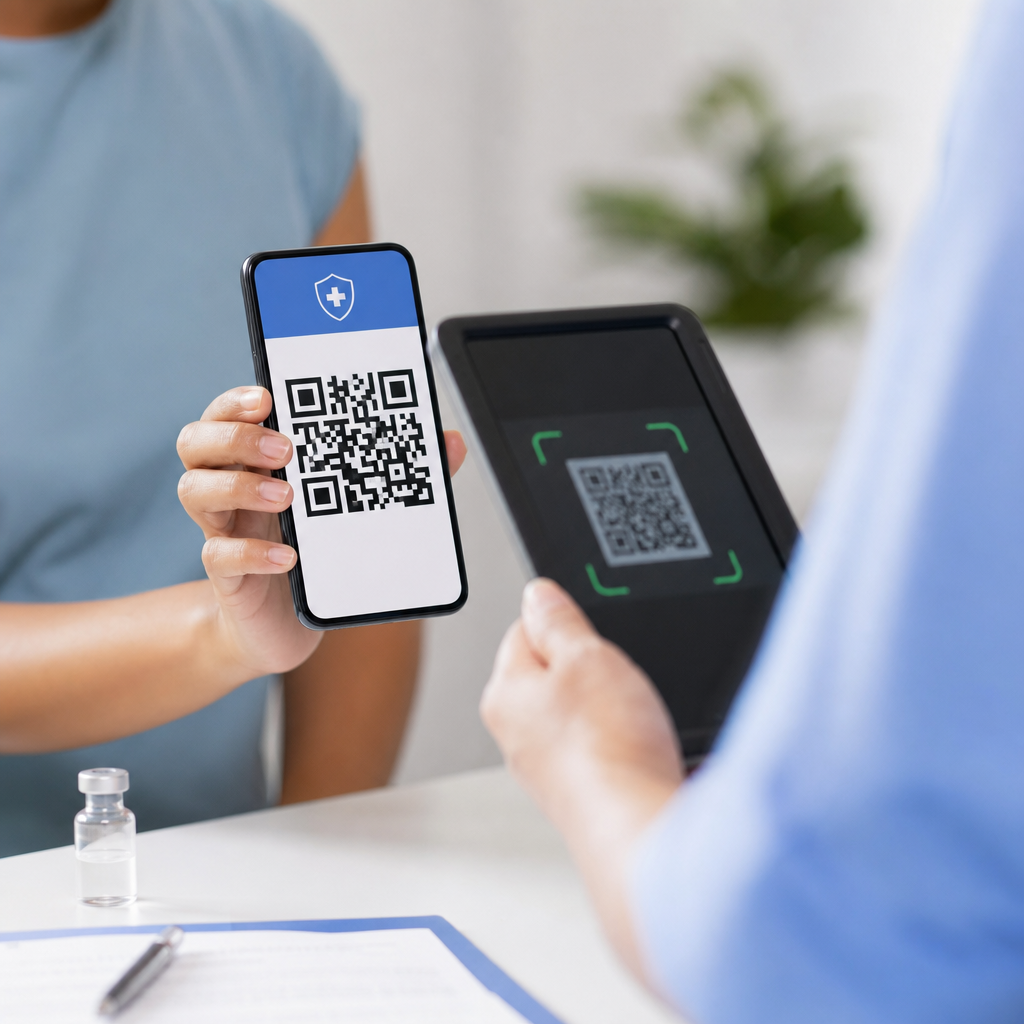
A vaccination QR code can function in two primary ways. First, it can contain signed data directly in the code itself, allowing an approved scanner to validate the record without contacting a remote server. Second, it can contain a secure link or identifier that retrieves the record from a trusted database. Both approaches are used in healthcare, and each has tradeoffs. Embedded data supports offline verification and quick presentation. Linked records allow real-time updates, revocation, and tighter access control.
In practice, the most effective systems rely on structured immunization data generated at the point of care. That data usually originates in an EHR, pharmacy platform, or immunization information system and includes patient demographics, vaccine code sets such as CVX, administration date, manufacturer, and administering organization. The QR code then packages or references that information in a standard format. During scanning, the receiving system checks the digital signature or queries the source record, confirming that the record was issued by a trusted entity and has not been altered.
SMART Health Cards became the most recognized framework for COVID-19 vaccination credentials in the United States and Canada because they allowed a patient to carry a digitally signed copy of key vaccination data. The code could be scanned by a verifier app, which checked the issuer’s public key. That model demonstrated an important lesson for healthcare: verification must be fast, but trust depends on cryptography, issuer directories, and consistent data fields. A QR image without those controls is merely a shortcut, not a reliable credential.
Clinical usability also matters. If staff need multiple apps, repeated logins, or manual exception handling, adoption drops quickly. In real deployments, the best results come when the QR workflow is embedded inside the check-in, discharge, patient portal, or occupational health process already in use. A pediatric office might generate a refreshed school immunization QR code from the portal, while a hospital employee health team might scan incoming records directly into onboarding software. The technology succeeds when it removes steps rather than adding them.
Key healthcare use cases across providers, public health, and patient access
QR codes for vaccination records support several distinct healthcare use cases, and each has different operational priorities. In ambulatory care, the focus is often speed and record completeness. A family medicine clinic can scan a patient’s immunization credential, reconcile doses with the chart, and identify gaps before a preventive visit. In pharmacies, where vaccinations are delivered at scale, QR codes help connect administration events to patient-facing proof while reducing the burden on staff who field frequent requests for replacement records.
Hospitals and health systems use QR-based vaccination records in employee health, pre-admission workflows, and discharge planning. For example, new hires may need influenza, hepatitis B, MMR, varicella, or COVID-19 documentation before patient-facing work begins. A scannable, verifiable record shortens occupational health review and reduces back-and-forth with prior employers. In maternal and pediatric settings, parents can present consolidated immunization credentials during specialist visits, helping teams verify schedules without waiting for faxed records from outside practices.
Public health agencies benefit because mass immunization events generate enormous documentation volume. During emergency vaccination campaigns, paper cards can be lost or misread, and call centers become overwhelmed with record requests. Issuing QR-backed digital records gives residents durable access while allowing agencies to maintain a trusted source of truth. Schools, universities, and long-term care facilities also benefit from easier verification when they must confirm coverage for enrollment, campus housing, or outbreak response.
Travel medicine and cross-border mobility are another major driver. Airlines, border authorities, universities abroad, and multinational employers may request proof of specific immunizations. A paper card may be accepted in one setting and rejected in another because authenticity is unclear. A digitally signed QR credential provides stronger assurance. That does not eliminate policy differences between jurisdictions, but it improves portability. Patients appreciate this because the record is easier to store in a phone wallet or portal than a paper document carried for years.
| Healthcare setting | Primary goal | Operational benefit |
|---|---|---|
| Primary care clinic | Reconcile immunization history | Faster intake and fewer manual entries |
| Pharmacy | Issue proof at scale | Reduced replacement card requests |
| Hospital employee health | Verify staff compliance | Quicker onboarding and audit readiness |
| Public health program | Support mass vaccination records | Better resident access and lower call volume |
| School or university clinic | Confirm enrollment requirements | Simpler validation across providers |
Standards, interoperability, and integration requirements
Interoperability determines whether a vaccination QR code remains useful beyond the issuing organization. In healthcare, that means aligning with recognized standards rather than inventing a proprietary format. FHIR is central because it offers a common resource model for exchanging immunization data, patient identifiers, and related provenance. SMART Health Cards built on this foundation by defining how to package selected clinical data into a signed credential. HL7 messaging, IIS connections, and terminology standards such as CVX and MVX remain essential for upstream data quality.
Integration starts with the source system. If the EHR or pharmacy platform cannot reliably capture product details, administration dates, and patient identity, the QR output will inherit those weaknesses. I have seen organizations focus heavily on the visual credential while neglecting duplicate patient cleanup, incomplete lot number capture, and mismatched demographic records. Those issues surface later during verification and undermine trust. A successful deployment therefore begins with immunization data governance, not with graphic design or mobile app selection.
Healthcare organizations should also think carefully about verification pathways. Some verifiers need online access to current status. Others, such as school nurses, event staff, or community organizations, may scan in low-connectivity environments. That is why hybrid models matter. A signed credential can prove that a record was issued by a trusted health entity, while a linked endpoint can provide updated details when connectivity is available. Governance over issuer keys, certificate rotation, and revocation procedures is part of the implementation, not an optional enhancement.
Vendor coordination is another practical requirement. EHR companies, state immunization registries, digital wallet providers, and check-in platforms do not always move at the same pace. Before launching, define who creates the credential, who stores the signing keys, who supports scanner updates, and how exceptions are handled when a patient’s name changes or a historical dose is corrected. Strong healthcare interoperability is as much about operational agreements as technical APIs.
Privacy, security, and compliance considerations
Vaccination records are protected health information when tied to an identifiable person, so any QR implementation must be designed around minimum necessary access, consent, and secure transmission. A common mistake is putting too much data directly into the code, then assuming convenience justifies the exposure. In most cases, the credential should include only the information required for the verification purpose. If a school needs confirmation of required immunizations, it may not need the broader clinical history visible in a general medical record.
Security controls should include digital signatures, encryption where applicable, key management, access logging, and strict validation of scanner applications. Organizations subject to HIPAA need business associate agreements where vendors handle protected data, and they should review state privacy laws that may impose additional requirements around immunization information. The Office of the National Coordinator’s interoperability rules, while not written specifically for QR credentials, reinforce the expectation that patients can access and share their data in usable digital forms.
Patient trust depends on transparency. Explain what the code contains, who can scan it, whether it links back to a live record, and how the patient can revoke or replace it. Also plan for equity. Not every patient has a smartphone, stable internet access, or comfort with digital wallets. Paper records and portal downloads should remain available. The strongest healthcare programs treat QR codes as an access option, not the only channel.
Implementation best practices and common pitfalls
Start with one high-value workflow, then expand. In my experience, employee health, pharmacy vaccination programs, and patient portal distribution are the best initial targets because demand is clear and the process boundaries are manageable. Define success metrics such as reduction in manual verification time, percentage of digitally issued records, scanner success rate, and patient retrieval rates. Train staff on what a valid credential looks like, when to trust it, and how to handle exceptions without sending patients into a support loop.
Common pitfalls are predictable. First, organizations underestimate data cleanup. Second, they roll out verifier tools without testing in real front-desk conditions. Third, they ignore downstream users such as schools, employers, and partner clinics that need simple instructions. Fourth, they fail to maintain issuer directories and key rotation, which eventually breaks trust. Finally, they assume the QR code alone solves interoperability. It does not. The code is only as reliable as the record lifecycle behind it.
QR codes for vaccination records work best when healthcare leaders treat them as part of digital health infrastructure rather than a one-off document feature. Done well, they shorten verification, improve patient access, support public health reporting, and make immunization data more portable across the healthcare ecosystem. The path forward is clear: standardize the data, secure the credential, integrate the workflow, and give patients a trustworthy way to carry proof when it matters. If your organization is modernizing immunization workflows, begin with a focused pilot and build from there.
Frequently Asked Questions
What is a QR code for a vaccination record, and what information does it usually contain?
A QR code for a vaccination record is a scannable, machine-readable code that either stores key immunization details directly or links to a secure digital record maintained by a healthcare provider, pharmacy, state registry, or authorized health platform. Its purpose is to make vaccination information faster to access, easier to verify, and more consistent across healthcare and administrative settings. Instead of relying only on paper cards or manually entered records, organizations can scan the code and retrieve the relevant data in seconds.
In most cases, the underlying vaccination record includes core documentation such as the patient’s name, date of birth, vaccine type or product, manufacturer, lot number, dose number, date administered, and the name or location of the provider who gave the vaccine. Some systems also include a record identifier, issuing authority, and a digital signature or encryption layer to help confirm that the record is authentic and has not been altered. The exact format varies by system, but the overall goal is the same: to create a reliable, portable way to connect a person to accurate immunization data.
It is also important to understand that not every QR code works the same way. Some contain only a limited set of encoded information, while others function more like a secure key that opens a protected record when scanned by an approved app or system. That distinction matters because it affects privacy, interoperability, and how the record is used in real-world settings such as clinics, schools, travel checkpoints, or employer health programs.
Why are QR codes becoming so important for vaccination records in modern healthcare?
QR codes have become increasingly important because healthcare systems need documentation that is fast, accurate, portable, and easy to verify across many different environments. Vaccination records are no longer used only inside a single doctor’s office. They may be needed by hospitals, urgent care centers, pharmacies, schools, colleges, employers, insurers, public health agencies, and, in some cases, travel authorities. A QR code helps bridge those settings by making the record easier to retrieve and confirm without depending entirely on paper copies or manual transcription.
From an operational standpoint, QR-enabled records can reduce administrative friction. Staff can scan a code rather than re-enter vaccine details by hand, which lowers the risk of clerical errors, misspellings, incorrect dates, or incomplete records. This is especially valuable during high-volume vaccination campaigns, seasonal immunization efforts, school enrollment periods, and public health responses where speed and consistency matter. A standardized scannable record can also support better reporting to immunization information systems and improve record matching across organizations.
There is also a trust and verification benefit. Traditional paper records can be lost, damaged, or difficult to authenticate. A QR code tied to a secure record can include verification features that make it easier to determine whether the information came from a legitimate source. For healthcare leaders and administrators, that combination of efficiency and reliability is why QR codes have moved from a nice-to-have feature to a core part of modern healthcare documentation infrastructure.
Are QR code vaccination records secure and private?
They can be secure and privacy-conscious, but their safety depends on how the system is designed, implemented, and managed. A well-built QR code vaccination record system typically uses safeguards such as encrypted data, secure record hosting, access controls, digital signatures, and limited data sharing. In many cases, the QR code itself does not expose a full medical file. Instead, it may contain only a reference token or a small amount of essential information needed for verification, with the complete record stored behind a protected system.
Privacy is especially important because vaccination records are part of a person’s health information. Organizations that issue or verify QR code records should follow applicable legal and regulatory requirements, apply strong cybersecurity practices, and collect only the minimum information needed for the intended use. For example, a school or employer may only need to confirm that required immunizations are complete, not access unrelated medical history. Good systems are designed with that principle in mind, limiting unnecessary disclosure and reducing the risk of overexposure of personal data.
That said, no system is automatically secure just because it uses a QR code. Risks can arise if codes are shared carelessly, stored in unsecured screenshots, linked to weak portals, or scanned through untrusted tools. Patients and organizations should use official apps or approved platforms, verify the source of the record, and understand what information is displayed when the code is scanned. In short, QR codes can support strong privacy and security, but only when they are backed by responsible data governance and modern technical protections.
How are QR codes for vaccination records used by clinics, schools, employers, and public health agencies?
Different organizations use QR code vaccination records in different ways, but the common benefit is faster, more dependable proof of immunization. In clinical settings, providers can scan the code to review prior doses, confirm vaccine schedules, and document newly administered vaccines with fewer manual steps. This can improve continuity of care, reduce duplicate vaccinations, and help clinicians make more informed decisions when patients receive care from multiple locations over time.
Schools and universities often use vaccination documentation during enrollment, registration, and compliance reviews. A QR-enabled record can streamline verification of required immunizations and make it easier for administrators to confirm whether a student meets entry requirements. Employers may use similar processes in occupational health programs, especially in industries where vaccination status is relevant to workplace safety or job-specific exposure requirements. In these settings, the speed of scanning and verification can reduce administrative burden while improving consistency in record review.
Public health agencies benefit as well because QR-based records can support cleaner reporting, faster validation, and better coordination across health systems. During outbreaks, mass vaccination events, or population-level immunization initiatives, a scannable record format can help agencies track coverage, identify gaps, and improve the movement of information between providers and registries. The broader value is not just convenience for one person or one organization, but a more connected documentation ecosystem that supports care delivery, compliance, and public health planning.
What should patients and organizations look for when choosing a QR code vaccination record solution?
Patients and organizations should start by evaluating accuracy, legitimacy, and interoperability. The record should come from a trusted issuer such as a healthcare provider, pharmacy, health system, or authorized registry, and it should reflect complete, up-to-date immunization data. A useful solution should also work across common care and verification environments, rather than being locked into a narrow proprietary system that cannot be easily recognized by other providers, schools, or agencies.
Security and privacy should be top priorities. Look for features such as encrypted data handling, authenticated access, tamper-evident verification, minimal data exposure, and clear policies on who can scan the code and what information they can view. It is also wise to assess whether the solution includes audit trails, identity verification, secure record updates, and support for replacing or revoking records if needed. For organizations, these features are not optional extras; they are central to compliance, trust, and risk management.
Finally, usability matters. A strong QR code vaccination record solution should be easy for patients to access on a phone or print if necessary, simple for staff to scan, and flexible enough to support real-world workflows. It should also provide clear guidance on what the code does, what information it contains, and how to use it safely. The best solutions balance convenience with control: they make vaccination records more portable and easier to verify while protecting the integrity and confidentiality of the underlying health information.