
Using AI to optimize QR code campaigns turns a static square into a measurable, adaptive marketing channel. A QR code campaign is any effort that uses scannable codes to move people from a physical or digital surface to an online action, such as visiting a landing page, downloading an app, registering for an event, or unlocking loyalty rewards. AI, in this context, means machine learning models, predictive analytics, natural language tools, and automation workflows that improve targeting, creative, timing, routing, and reporting. When these systems are connected well, QR codes stop being simple links and become responsive touchpoints that learn from every scan.
This matters because QR performance is shaped by many variables at once: placement, audience intent, device type, offer quality, page speed, geography, time of day, and the wording around the code. In campaigns I have managed for retail, events, and field marketing, the same destination URL performed very differently depending on sign design, local traffic patterns, and whether the code led to a generic page or a personalized experience. AI helps teams process those variables faster than manual reporting can. It can identify which print placements drive qualified scans, predict drop-off after the scan, and automatically route people to the experience most likely to convert. For brands investing in packaging, direct mail, out-of-home, in-store displays, or product education, that translates into lower waste and stronger conversion rates.
As a hub topic, QR codes plus AI and automation includes several connected disciplines. Dynamic QR code management allows destinations to change without reprinting. Attribution connects scans to sessions, conversions, and revenue using platforms such as Google Analytics 4, CRM systems, and ad platforms. Personalization adapts the destination based on device, source, or customer status. Automation handles follow-up, lead scoring, notifications, and retargeting. Governance covers privacy, consent, security, accessibility, and operational control. The core principle is simple: every scan should produce data, every data point should improve the next experience, and every improvement should be governed by a clear business objective.
Build the measurement layer before adding intelligence
The first requirement for AI optimization is clean data. If a QR code sends traffic to an untagged page, no model can reliably explain performance. Start with dynamic QR codes tied to campaign IDs, creative variants, placement IDs, and dates. Append standardized UTM parameters, and capture first-party events on the landing page: page view, scroll depth, form start, form completion, add to cart, coupon save, or store locator click. In GA4, define conversions and audiences. In a CRM such as HubSpot or Salesforce, map the scan source to contacts, opportunities, or purchases. This is the foundation for scan-to-conversion analysis.
Teams often focus only on scan volume, but that metric can be misleading. A busy transit poster may produce many scans and few purchases, while a product package insert may generate fewer scans and much higher order value. Useful optimization metrics include unique scans, engaged sessions, bounce rate, time to conversion, assisted revenue, repeat scans, and downstream actions like email sign-up or sales call booking. I recommend separating metrics into three levels: acquisition quality, on-page engagement, and business outcomes. AI models perform better when trained on those clearer signals rather than on scan count alone.
Data hygiene also means handling duplicates, bots, and weak attribution. Some scanners prefetch URLs, which can inflate visits. Some users scan multiple times from the same device before converting. Use server-side logging where possible, compare scan timestamps to landing-page events, and establish a deduplication rule. If a code appears across many store locations, include location metadata in the redirect layer so AI can compare performance by region, weather, staffing level, or inventory status. Without that structure, optimization recommendations will be noisy.
Use AI to improve targeting, creative, and destination matching
Once the data layer is reliable, AI can answer the practical questions marketers ask. Which offer should appear after the scan? Which audience segment is most likely to buy? Which wording near the code increases scan intent? Predictive models can score traffic based on variables such as placement type, previous customer behavior, local inventory, and historical conversion rate. A retailer, for example, can show store-specific promotions when the scan happens near a location with excess stock, while new visitors receive educational content and loyalty members receive replenishment reminders.
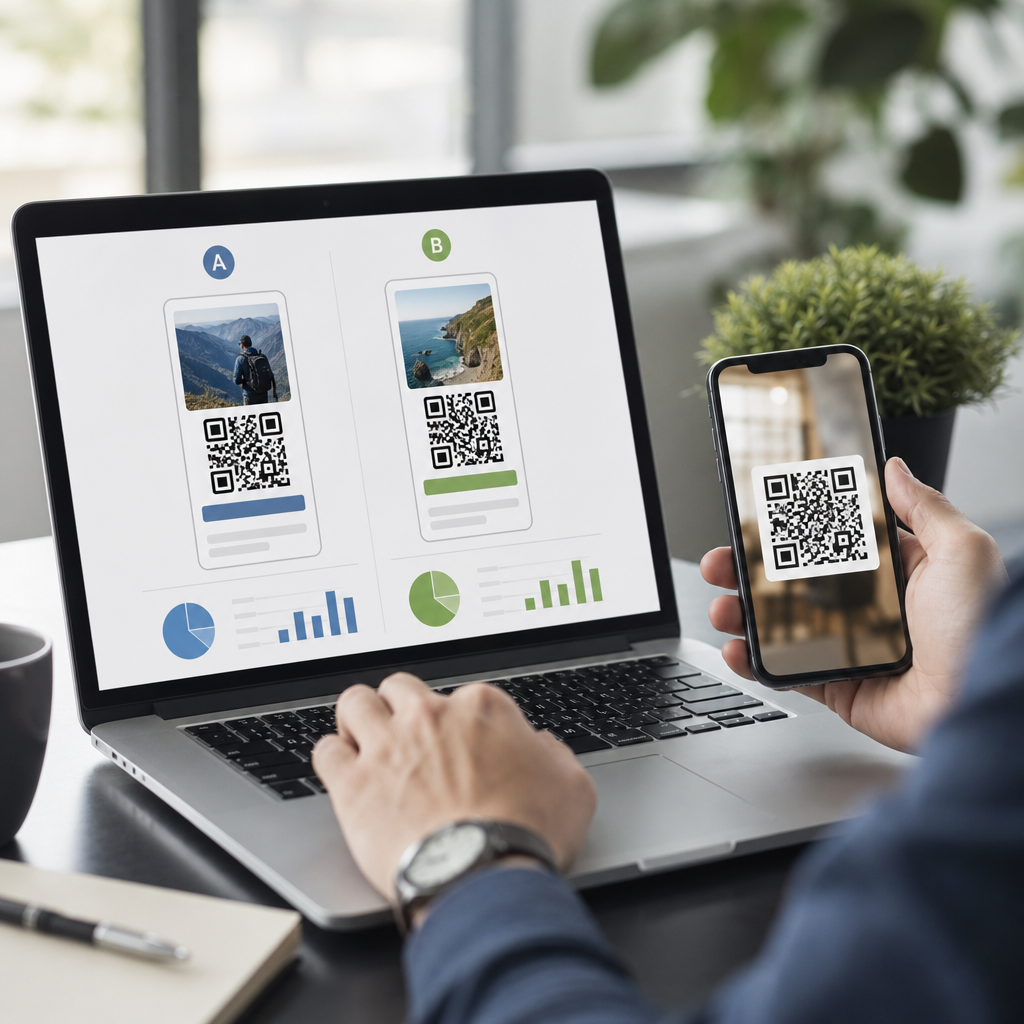
Natural language tools are especially useful for testing call-to-action copy beside the QR code and on the landing page. Small wording changes matter. “Scan for menu” signals low commitment, while “Scan for today’s chef specials” adds urgency and specificity. In event campaigns, “Scan to join the waitlist” performs differently from “Scan to reserve your seat,” because the second phrase implies certainty and value. AI can generate variants, cluster themes, and identify which phrasing works best by audience or context, but human review remains essential to keep claims accurate and on-brand.
Destination matching is where many QR campaigns win or lose. Sending every scan to the homepage wastes intent. AI-driven routing can adapt the destination using known factors: language, device operating system, referral source, time, and prior behavior. A pharmaceutical conference booth might route physicians to prescribing information, procurement staff to a contact form, and job seekers to careers pages based on the path they took before scanning and the questions they ask on-page. This is not guesswork; it is rules-based personalization improved by predictive scoring and continuous testing.
| Optimization area | What AI analyzes | Practical action | Example outcome |
|---|---|---|---|
| Placement performance | Location, time, device, historical conversions | Shift budget to higher-intent placements | Fewer scans, more purchases from package inserts than posters |
| CTA wording | Text variants, scan rate, conversion rate | Replace weak prompts with specific benefit-led copy | “Scan for 10% off today” outperforms “Learn more” |
| Landing page routing | User segment, inventory, geography, device | Send visitors to tailored pages | Store-local offers lift redemption rates |
| Lead qualification | On-page behavior, form inputs, CRM history | Score leads and trigger sales follow-up | Sales team prioritizes high-intent booth scans |
Connect automation to the post-scan journey
Optimization does not stop at the scan. The post-scan journey determines whether interest becomes revenue. Automation platforms such as Zapier, Make, HubSpot Workflows, Salesforce Flow, and Braze can turn QR interactions into immediate actions. A scan can add a contact to a nurture sequence, send a sales alert, issue a coupon, update a lead score, create a support ticket, or trigger retargeting. In hospitality, a table tent scan can launch a menu, collect preferences, and follow up with a return-visit offer. In B2B events, a booth scan can deliver a product sheet and assign the lead to a regional representative within seconds.
Good automation is event-driven and restrained. If every scan triggers an email blast, unsubscribe rates will rise. Use conditional logic. For example, first-time scanners may get education, while repeat scanners who viewed pricing receive a demo invitation. If a user scans from packaging after a purchase, the workflow should focus on onboarding, product registration, and support resources, not another acquisition message. This is where AI and automation complement each other: AI predicts next-best action, and automation executes it consistently across channels.
Closed-loop reporting is essential. Feed downstream outcomes back into the optimization system so models learn from actual value, not superficial engagement. If one QR placement creates many form fills that never become qualified leads, the system should reduce emphasis on that source. If another placement produces fewer scans but higher retention or repeat purchase rate, it deserves more inventory and creative attention. This feedback loop is what elevates QR code campaigns from a tactic to an improving program.
Apply governance, privacy, and operational controls
AI-enhanced QR programs need clear guardrails. Privacy rules differ by jurisdiction, and a scan can still become personal data processing once it is tied to identifiers, location, or CRM records. Publish transparent notices, collect consent where required, and minimize unnecessary data capture. For sensitive industries, avoid exposing confidential parameters in redirect URLs and use secure redirect domains with access control. QR codes can also be abused through sticker replacement or malicious redirects, so physical inspection and managed domains are part of campaign hygiene.
Operationally, establish ownership for code generation, redirect editing, analytics QA, and incident response. Broken redirects, expired certificates, or pages removed during site updates can quietly destroy campaign performance. I advise teams to maintain a redirect registry with naming conventions, expiration checks, and destination validation. Accessibility matters too: include clear instructions, sufficient contrast, and an alternative short URL for users who cannot scan. AI can improve performance, but disciplined execution keeps the channel trustworthy and scalable.
How to scale this subtopic into a complete QR strategy
This hub connects the full QR codes plus AI and automation stack. The next layers usually include dynamic versus static QR code strategy, AI-driven landing page personalization, CRM and marketing automation integrations, QR attribution in GA4, predictive lead scoring, local inventory routing, AI copy testing for scan prompts, event QR workflows, packaging QR lifecycle campaigns, and governance for privacy and security. Treat each as a modular capability. Start with one high-intent use case, such as product packaging or trade show lead capture, prove the measurement model, then expand.
The main benefit is precision. AI helps you place better codes, present better offers, route people to better destinations, and automate better follow-up. The result is not just more scans, but more valuable outcomes from every printed asset, sign, package, or display. Review your current QR campaigns, identify where data is missing, and build the first closed-loop workflow. Once you can measure each scan to business impact, optimization becomes systematic rather than speculative.
Frequently Asked Questions
What does it mean to use AI to optimize a QR code campaign?
Using AI to optimize a QR code campaign means applying data analysis, prediction, and automation to improve how QR codes perform across the entire customer journey. Instead of treating a QR code as a simple link printed on packaging, posters, menus, direct mail, or product displays, AI helps turn that code into a measurable and adaptable marketing channel. It can analyze scan behavior, time of day, location patterns, device types, customer segments, conversion rates, and engagement signals to identify what is working and what is not.
In practice, AI can support better decision-making before, during, and after a campaign. Before launch, it can help forecast likely scan volume, identify the best audience segments, and recommend placements or calls to action. During the campaign, it can monitor performance in near real time and trigger changes such as redirecting users to different landing pages, adjusting offers, or personalizing messaging based on user behavior. After the campaign, it can surface patterns that marketers may miss on their own, such as which design variations produce stronger engagement or which environments generate high scan rates but weak conversions.
The real advantage is that AI allows marketers to move from reactive reporting to proactive optimization. Rather than simply counting scans, brands can use AI to understand intent, predict outcomes, and refine campaign strategy continuously. That makes QR code campaigns more accountable, more personalized, and far more effective than traditional static deployments.
How can AI improve the performance of QR code campaigns?
AI improves QR code campaign performance by making each stage of the campaign smarter and more responsive. One of the biggest gains comes from audience targeting. AI models can combine historical campaign data, customer behavior, purchase history, geography, and channel context to predict which audience segments are most likely to scan and convert. That helps marketers place QR codes where they are most likely to drive action rather than relying on broad assumptions.
AI also strengthens creative and messaging decisions. It can evaluate which headlines, incentives, visuals, landing page layouts, or offers are most likely to produce scans and post-scan conversions. For example, one QR code printed on in-store signage may perform better with a “Get instant savings” message, while a direct mail QR code may perform better with “See your personalized offer.” AI can detect these differences faster than manual review and recommend or automate changes accordingly.
Another major benefit is dynamic optimization. If a QR code points to a dynamic URL, AI can help route users to the most relevant destination based on context such as device type, time, location, referral source, or previous interactions. This creates a more personalized experience and reduces friction after the scan. AI can also identify drop-off points in the conversion funnel, flag underperforming placements, detect anomalies, and suggest budget or placement shifts based on expected return.
Ultimately, performance improves because AI helps marketers test more efficiently, personalize more accurately, and respond to live campaign data with speed and precision. That leads to stronger engagement, higher conversion rates, and a clearer understanding of what drives measurable business outcomes from QR code efforts.
What data should businesses track when using AI for QR code marketing?
To use AI effectively in QR code marketing, businesses need to track much more than total scan counts. Basic scan metrics are a starting point, but optimization depends on richer contextual and downstream data. Important top-level metrics include number of scans, unique scans, repeat scans, scan time, date, device type, operating system, browser, and approximate location. These details help AI models identify behavioral patterns and performance differences across audience segments and environments.
Beyond the scan itself, businesses should track what happens after the user lands on the destination page. That includes bounce rate, time on page, click-through rate, form completions, purchases, app downloads, event registrations, loyalty sign-ups, coupon redemptions, and any other meaningful conversion action. If the goal is revenue, then order value, product category, repeat purchase behavior, and assisted conversions are especially important. AI becomes much more useful when it can connect scan activity to outcomes rather than treating every scan as equal.
Campaign context is also critical. Marketers should label QR codes by placement, creative version, distribution channel, offer type, campaign date range, audience segment, and physical location. A code on product packaging behaves differently from one on a window display or conference badge, and AI needs those distinctions to make useful recommendations. If possible, businesses should also integrate CRM, email, paid media, and point-of-sale data to build a more complete picture of user behavior across channels.
Good data quality matters as much as data volume. Clean naming conventions, consistent event tracking, privacy-conscious collection practices, and a clear definition of success are essential. When the data is structured properly, AI can reveal which QR code experiences attract attention, which ones convert, and which factors most strongly influence campaign performance over time.
Can AI personalize the experience after someone scans a QR code?
Yes, and this is one of the most valuable ways AI can elevate a QR code campaign. A static QR code does not have to lead every user to the same generic destination. When paired with dynamic routing, AI can help determine the most relevant post-scan experience based on contextual signals and known user data. That might include language preference, location, device type, time of day, returning versus new visitor status, past purchase behavior, or the specific campaign source tied to that QR code placement.
For example, a restaurant QR code could show different menu promotions depending on local inventory and time of day. A retail brand might send first-time scanners to an introductory offer, while returning customers see loyalty rewards or product recommendations. At an event, attendees could scan the same code but receive personalized agendas, booth suggestions, or follow-up content based on their registration profile. AI makes these decisions more intelligent by learning which experiences are most likely to drive engagement or conversion for each user context.
Natural language tools can also improve personalization by adapting on-page copy, chatbot responses, or support flows after the scan. Predictive models can estimate the user’s likelihood to convert and tailor the experience accordingly, such as showing a stronger incentive to hesitant users or a faster checkout flow to high-intent users. Over time, AI can learn which combinations of content, offer, and timing produce the best outcomes and continuously refine the journey.
The key is to balance personalization with privacy and usability. Businesses should be transparent about data usage, avoid overly intrusive experiences, and ensure the destination loads quickly and clearly on mobile devices. When implemented thoughtfully, AI-powered personalization can make a QR code feel less like a generic link and more like a relevant, timely interaction that moves users smoothly toward action.
What are the biggest best practices and common mistakes when using AI in QR code campaigns?
One of the most important best practices is to start with a clear objective. AI is most effective when it is optimizing toward a defined goal, such as increasing scans, improving landing page engagement, driving purchases, boosting event registrations, or growing loyalty participation. Without a clear success metric, even sophisticated AI tools can produce insights that are interesting but not actionable. Businesses should also use dynamic QR codes whenever possible, since they allow destinations, tracking, and optimization logic to change without reprinting the code.
Another best practice is to connect the QR code experience to a strong mobile destination. AI can help improve targeting and personalization, but it cannot fix a slow page, confusing offer, or poor user experience. The landing page should load quickly, match the promise made near the code, and make the next step obvious. It is also wise to test variables systematically, including placement, size, surrounding text, color treatment, incentive, and destination content. AI works best when it has structured testing data to learn from rather than inconsistent campaign execution.
On the mistake side, many brands focus too heavily on scan volume and ignore downstream conversion quality. A placement that generates many scans may still fail if visitors bounce or do not complete the intended action. Another common error is failing to label and organize campaign data properly, which makes AI outputs less reliable. Some marketers also adopt automation too early without human review, leading to irrelevant recommendations or brand messaging that feels disconnected from the customer context.
Privacy and compliance mistakes are also significant. Businesses should collect only the data they need, follow applicable regulations, and be transparent about how information is used. Finally, brands should avoid treating AI as a one-time setup. The strongest results come from ongoing monitoring, retraining, experimentation, and refinement. AI can dramatically improve QR code campaigns, but its value depends on quality data, sound strategy, strong creative execution, and regular human oversight.