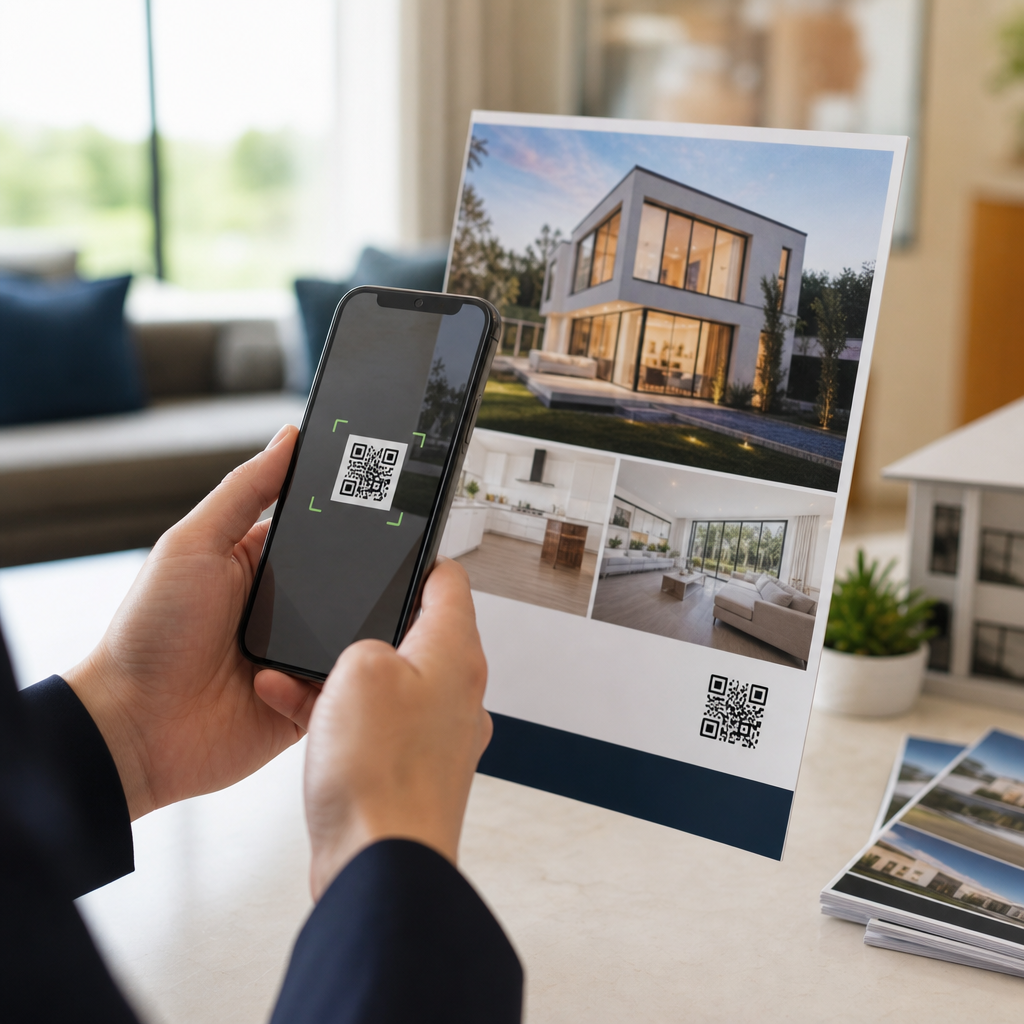
QR codes for real estate brochures turn a static handout into a measurable, mobile-first sales tool. In practice, that means a printed flyer, tri-fold brochure, or property sheet can send a buyer from paper to a virtual tour, floor plan, financing form, or agent contact page in seconds. A QR code is a scannable matrix barcode that opens digital content when viewed through a smartphone camera. For real estate, that simple bridge matters because property marketing now happens across print, search, social platforms, listing portals, and text messaging at the same time. Buyers expect immediate access to photos, neighborhood details, and next-step actions, even when they first discover a property from a box flyer or an open-house handout.
I have used QR codes across single-property brochures, new development packets, direct-mail postcards, and signage campaigns, and the pattern is consistent: when the destination is useful and the design is intentional, scans increase qualified engagement. Real estate teams also gain something brochures alone cannot provide: attribution. A printed brochure can be expensive to design, print, and distribute, but without a scan layer, it is hard to know which property sheet drove interest. A dynamic QR code tied to analytics changes that. It can reveal which listings attract curiosity, which calls to action perform best, and where a prospect drops off after scanning. That insight helps brokers improve both marketing efficiency and client service.
As the central hub for real estate QR code strategy, this guide covers the decisions that matter most: what to link to, how to design brochure-ready codes, how to measure results, where implementation fails, and how this tactic fits residential, commercial, rental, and new-construction marketing. The goal is not to add technology for its own sake. The goal is to make real estate brochures more informative, more convenient, and more likely to convert casual interest into a showing, inquiry, or signed lead form.
Why QR codes work so well in real estate brochures
Real estate is a high-consideration purchase with a fragmented decision journey. A buyer may see a brochure at an open house, revisit the property later, compare it against three similar listings, and then share the link with a spouse or lender. QR codes reduce friction at every stage because they remove the need to type long URLs, search for an address, or remember an agent’s name. On mobile, that friction reduction is decisive. According to the National Association of Realtors, buyers rely heavily on mobile devices during home search, and listing media strongly influences perceived property value. A brochure with a well-placed QR code meets that behavior directly.
They also support how modern agents actually market inventory. Print remains useful because brochures are tangible, portable, and trusted in in-person settings. Yet print alone cannot carry a full media package. A brochure can summarize square footage, price, features, and location, but it cannot display a full Matterport tour, drone footage, school maps, HOA documents, or prequalification options. A QR code extends the brochure into a digital property experience without overcrowding the page. For luxury listings, that may mean a cinematic landing page. For multifamily leasing, it may mean current availability. For commercial real estate, it may mean zoning information, cap rate assumptions, and tenant mix.
Another reason QR codes perform well is timing. In real estate, interest often peaks the moment a prospect encounters the property. If the brochure offers an instant path to book a showing or text an agent, the prospect acts while intent is highest. Delayed follow-up usually lowers conversion. I have seen this repeatedly in open-house campaigns: brochures linked to a simple mobile page with photos, disclosures, and a scheduling form outperform brochures that only list a website and phone number, because the user does not have to switch context or search manually.
What a real estate brochure QR code should link to
The most common mistake is linking every brochure QR code to the homepage. That wastes user intent. The destination should match the context of the brochure and the stage of the buyer journey. On a single-property brochure, the best destination is usually a dedicated listing landing page with hero photos, property highlights, map, floor plan, showing request form, and agent contact details. On a neighborhood market report, the code should lead to a local guide or valuation page. On a new-development brochure, it may open an availability grid, interactive site plan, or reservation inquiry form.
Useful destinations fall into several categories: immersive media, decision support, lead capture, and trust-building content. Immersive media includes virtual tours, video walkthroughs, and image galleries. Decision support includes mortgage calculators, school district pages, commute maps, and downloadable disclosures. Lead capture includes showing schedulers, “request pricing” forms, and SMS opt-ins. Trust-building content includes agent bios, recent sales, testimonials, and market updates. The brochure should promise exactly what the scan delivers. If the print says “Scan for 3D tour,” the code must open the 3D tour immediately, not a portal page with ten competing actions.
| Brochure Type | Best QR Destination | Primary Goal |
|---|---|---|
| Single-property flyer | Dedicated listing page with gallery, facts, map, and showing form | Generate inquiries |
| Open-house handout | Mobile page with disclosures, 3D tour, and follow-up form | Capture warm leads |
| Luxury brochure | High-resolution branded microsite or cinematic video page | Increase perceived value |
| Rental brochure | Live availability and application page | Drive applications |
| Commercial brochure | Property package with zoning, plans, rent roll, and contact form | Support due diligence |
Dynamic QR codes are especially valuable here because the destination can be updated without reprinting brochures. If price changes, a listing goes pending, or a leasing page needs fresh availability, the code remains the same while the target URL changes. That is critical in real estate, where inventory status changes quickly and print runs often outlive the first version of a listing page.
Design and placement rules that improve scan rates
A brochure QR code must be easy to notice, easy to trust, and easy to scan. Size is the first operational rule. For most brochures, a code should be at least 0.8 inches square, and larger if the brochure may be viewed at arm’s length or in dim lighting. Quiet space, the empty margin around the code, should remain unobstructed. Overdesigned codes fail when logos, gradients, or low-contrast color choices interfere with smartphone recognition. Black on white remains the most dependable option, though brand colors can work if contrast stays strong.
Placement matters almost as much as size. On property brochures, I place the code near the strongest action, usually beside the hero image, property summary, or contact block, not buried in the footer. Each code needs a clear label that tells the user what happens next: “Scan for virtual tour,” “Scan for full photo gallery,” or “Scan to book a showing.” Generic labels such as “Learn more” underperform because they create uncertainty. The best brochure layouts treat the QR code as a conversion element, not a decorative add-on.
Technical setup affects performance too. The landing page must be mobile optimized, fast, and free of intrusive pop-ups. Google’s Core Web Vitals are relevant here because slow pages reduce engagement, especially on cellular connections outside a listing. If the page takes too long to load, the benefit of the QR code disappears. Use compressed images, a responsive template, click-to-call buttons, and short forms. If compliance applies, include fair housing language, required disclosures, and consent language for text follow-up where applicable.
Measurement, lead quality, and campaign optimization
The strongest business case for QR codes in real estate brochures is measurability. A dynamic code platform can track scans by date, device type, and approximate location. When combined with UTM parameters in Google Analytics 4, broker CRM data, and call tracking, teams can connect brochure engagement to real outcomes. Useful metrics include unique scans, scan-to-lead rate, showing requests, application starts, time on landing page, and return visits. For teams with a longer sales cycle, influenced pipeline is a better measure than last-click attribution alone.
Lead quality improves when brochure destinations are segmented. A brochure handed out at an investor event should not send everyone to a general residential page. Instead, use property-specific or audience-specific destinations. For example, a multifamily investment brochure may link to a page with NOI assumptions, occupancy history, and downloadable OM access. A first-time buyer brochure can lead to a mortgage readiness checklist and neighborhood starter-home listings. Better alignment produces better downstream conversations because the prospect self-selects into relevant content.
Optimization should be deliberate. Test one variable at a time: call-to-action language, landing page format, or media type. In one campaign, replacing “Scan for details” with “Scan for price, tour, and disclosures” raised scans because the value exchange was explicit. In another, moving from a generic website link to a property-specific page increased time on site and showing requests. This is where brochure QR codes become part of a repeatable marketing system rather than a novelty feature.
Use cases across residential, rental, commercial, and development marketing
Residential resale is the most obvious use case, but it is only one segment. In standard home sales, QR codes support listing brochures, just-listed mailers, open-house packets, and neighborhood farming materials. For rentals, they streamline leasing by linking directly to unit availability, pet policies, fees, and online applications. Property managers benefit because prospects can move from interest to application without calling during office hours.
In commercial real estate, brochure QR codes are especially effective because the information burden is heavier. Office, retail, industrial, and land prospects need site plans, demographics, zoning, traffic counts, and financial summaries. A printed brochure cannot hold all of that cleanly. A QR code can open a secure property page or downloadable offering memorandum. For brokers, that means less back-and-forth sending basic files and more time spent with qualified prospects who have already reviewed the materials.
New developments and preconstruction projects also benefit. Developers often need to market before every detail is finalized. A dynamic code on a brochure can lead to updated floor plans, release schedules, incentive information, and waitlist forms as the project evolves. Because the code destination can change, printed collateral stays useful longer. Across all these categories, the principle remains the same: match the scan destination to the buyer’s immediate question, and conversion improves.
Common mistakes and the practices that prevent them
The biggest mistakes are strategic, not technical. Teams fail when they use one code for everything, link to irrelevant pages, ignore mobile speed, or never review scan data. Another common problem is placing a QR code on a brochure without supporting copy. People scan when they know the benefit. “Scan for neighborhood comps and tour times” is stronger than a silent square. Security perception matters too. Established branding, recognizable domain names, and a brief description of the destination increase trust.
Keep governance simple. Maintain a naming convention for campaigns, document each destination URL, and test every printed code on multiple devices before production. If a listing expires, redirect the code to a relevant alternative instead of letting it break. Train agents to mention the brochure QR code in person: a verbal prompt often increases scans. When these basic disciplines are in place, QR codes for real estate brochures become a durable part of the marketing stack, not a one-off experiment. Start with one high-intent brochure, measure scans and leads, and expand from there.
Frequently Asked Questions
How do QR codes improve real estate brochures?
QR codes make a real estate brochure far more than a static print piece. Instead of asking a buyer to type a long web address, search for a listing later, or remember property details after an open house, the brochure can instantly connect them to the next step with a quick scan. That next step might be a virtual tour, high-resolution photo gallery, interactive floor plan, neighborhood guide, mortgage pre-qualification form, disclosure packet, or direct contact page for the listing agent. In practical terms, QR codes reduce friction. The easier it is for a prospect to move from interest to action, the more likely they are to stay engaged.
They also add a measurable layer to print marketing. Traditional brochures are useful, but they are difficult to track. With a QR code, agents and marketers can see how often a brochure is driving scans, when engagement happens, and which properties or calls to action generate the most interest. That data helps refine future campaigns, improve brochure design, and better understand buyer behavior. For real estate professionals, the value is twofold: buyers get a smoother, mobile-first experience, and agents gain clearer insight into which marketing assets are actually producing results.
What should a real estate brochure QR code link to?
The best destination depends on the buyer’s stage in the decision-making process, but the link should always serve a clear purpose. For a listing brochure, a property-specific landing page is often the strongest option because it can centralize the most important information in one place. That page might include listing photos, a video walkthrough, 3D virtual tour, floor plan, pricing details, property features, school information, and a contact form. This creates a more complete experience than sending someone to a general homepage where they may need to search again for the property.
Other effective destinations include open house registration pages, downloadable buyer packets, financing applications, calendar scheduling tools, or “request a showing” forms. In some cases, separate brochures may use different QR codes for different goals. One code could send buyers to a virtual tour, while another might launch a text message, phone call, or email draft to the agent. The key is alignment between the printed message and the digital destination. If the brochure headline promotes a virtual tour, the QR code should open that tour directly. If it encourages immediate contact, it should lead to a fast, mobile-friendly contact experience. Relevance, speed, and clarity are what make the scan worthwhile.
Where should a QR code be placed on a real estate brochure for the best results?
Placement has a major effect on whether people actually scan the code. A QR code should be easy to notice without overwhelming the brochure design. In most real estate brochures, strong placement options include the front panel, near the property’s main photo, beside a prominent call to action, or in the contact section where the buyer is already deciding what to do next. On a tri-fold brochure, the code often performs well on the cover or inside panel tied to the property highlights. On a single-sheet flyer, placing it in the upper half or near the main value proposition can increase visibility.
Just as important as placement is context. A QR code should never appear by itself without explanation. A short instruction such as “Scan for 3D Tour,” “View Floor Plan,” or “Book a Private Showing” gives the buyer a reason to act. Size matters as well: the code needs to be large enough to scan quickly from a normal reading distance, with enough white space around it to avoid scanning issues. Good contrast, clean printing, and a mobile-optimized destination all support better performance. In short, the best placement is wherever the code feels like a natural next step in the brochure’s flow, supported by a clear benefit and a simple call to action.
Can you track the performance of QR codes on printed real estate brochures?
Yes, and that is one of the biggest advantages of using QR codes in print marketing. While a standard printed brochure can be expensive to produce and distribute, it typically provides little direct feedback. QR codes change that by creating a trackable connection between offline materials and online engagement. Depending on the platform used, agents can often monitor scan counts, time and date of scans, device types, and sometimes general location data. This helps reveal how buyers are interacting with specific listings, neighborhoods, events, or marketing campaigns.
Tracking is especially helpful when testing different brochure versions or distribution strategies. For example, an agent might compare brochure performance at open houses, in direct mail campaigns, in office lobbies, or in relocation packets. If one property’s brochure gets many scans but few inquiries, that may indicate the landing page needs improvement. If another brochure drives strong contact form submissions, that design and call to action may be worth repeating. To get the most useful data, many marketers use dynamic QR codes, which allow the destination URL to be updated without reprinting the code and often include built-in analytics. This makes QR-enabled brochures not just informative, but strategically measurable and easier to optimize over time.
What are the best practices for creating effective QR codes for real estate brochures?
The most effective QR codes are built around convenience, trust, and a strong user experience. First, the destination should be mobile-friendly, fast-loading, and directly related to the property or action being promoted. Buyers scanning a brochure are usually on their phones, often while multitasking or moving between showings, so the experience has to be immediate and simple. A page that loads slowly, looks cluttered on mobile, or forces extra navigation can quickly lose a prospect’s attention. It is also important to use a clear call to action next to the code so people understand exactly what they will get by scanning.
Design and technical quality also matter. Use high contrast, adequate sizing, and enough margin around the code so smartphone cameras can read it easily. Test the code on multiple devices before printing, and verify that it works under realistic conditions, including different lighting and paper finishes. If branding is added, such as a logo in the center, it should not compromise scannability. From a marketing standpoint, it is smart to create a dedicated landing page for each listing or campaign rather than sending all scans to a generic website. Finally, keep the buyer journey in mind. The QR code should move the person toward a meaningful next step, whether that is viewing the home, learning more, scheduling a showing, or contacting the agent. When the code is purposeful, easy to scan, and tied to valuable content, it becomes a practical sales tool rather than just a visual add-on.