QR codes for lead capture in real estate turn offline attention into measurable digital action. In practical terms, a QR code is a scannable matrix barcode that opens a landing page, form, property brochure, video tour, map, calendar link, or contact card when a prospect points a phone camera at it. Lead capture is the process of collecting contact details and qualifying information from a potential buyer, seller, renter, investor, or referral partner. Put together, these tools help agents and brokers connect yard signs, brochures, open houses, direct mail, window displays, print ads, and event materials to a digital follow-up system.
This matters because real estate marketing still depends heavily on physical touchpoints. A sign rider on a busy street may generate hundreds of impressions, but without a direct response mechanism, most of that interest disappears. I have implemented QR campaigns for listings, leasing teams, and new-home communities, and the pattern is consistent: when the destination is fast, mobile-friendly, and relevant, scan-to-lead conversion is easier to attribute than a phone call from a sign. The code creates a bridge between curiosity and action, and that bridge can be measured with scan counts, form fills, source tags, and appointment bookings.
For a hub page on real estate, the key idea is that QR codes are not one tactic. They support multiple use cases across residential sales, commercial leasing, multifamily, property management, development, recruiting, and referral generation. They can route first-time buyers to financing guides, sellers to valuation forms, tenants to availability pages, and investors to offering summaries. The best programs combine scannable assets with CRM automation, clear privacy handling, concise calls to action, and strong on-page relevance so every scan answers the prospect’s immediate question.
How QR codes fit the real estate lead funnel
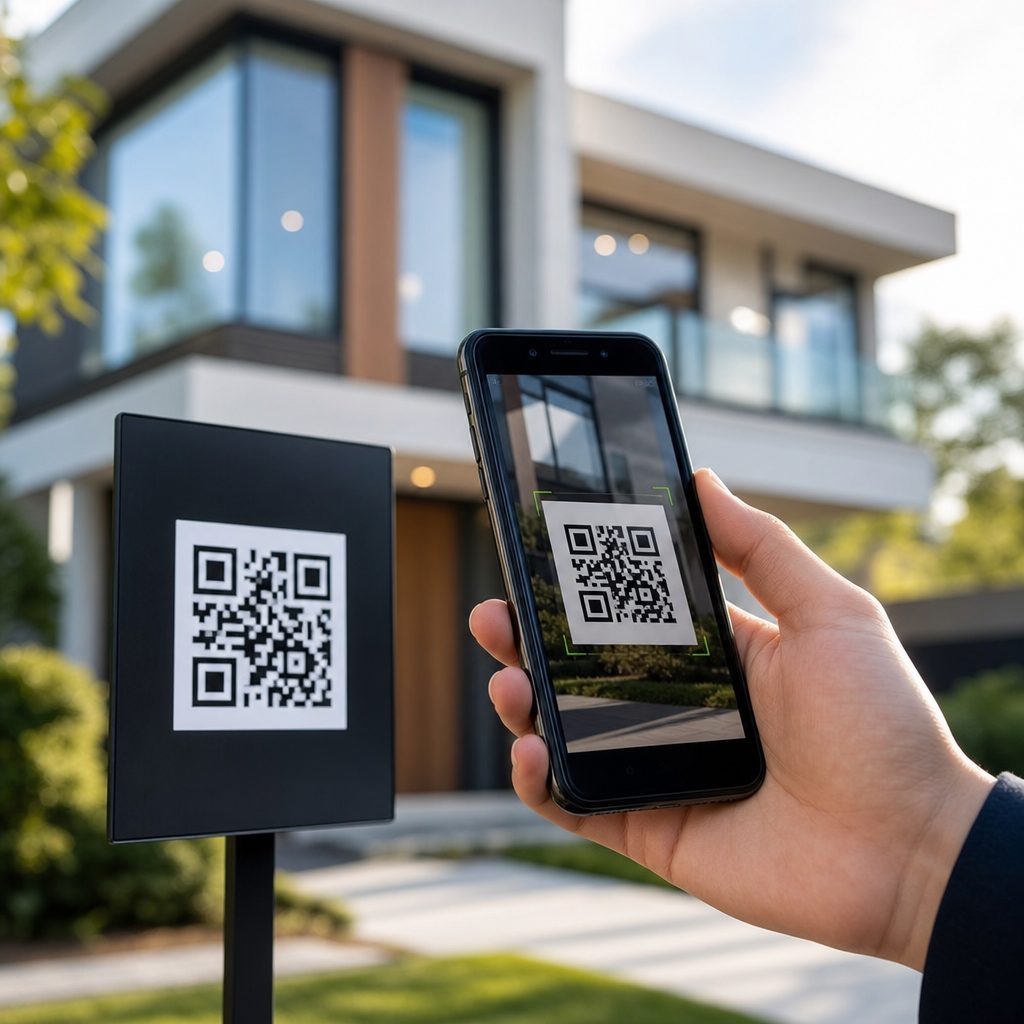
In real estate, the lead funnel usually begins with awareness, moves into interest and inquiry, then advances to qualification, tour scheduling, offer activity, and client nurture. QR codes are most effective in the awareness and inquiry stages because they reduce friction at the exact moment a prospect wants more information. A passerby sees a listing sign, scans, lands on a mobile page with photos, price, neighborhood highlights, and a short form, and then receives an automated text or email. That sequence is faster than asking someone to remember a URL or call later.
The strongest real estate QR destinations answer one primary question per context. On a yard sign, the question is usually “What is this property and how much does it cost?” At an open house, it becomes “How do I register and get disclosures?” In a farm mailer, it may be “What is my home worth?” In multifamily leasing, the question is “Are units available and can I schedule a tour?” Matching the destination to intent is the difference between casual scans and qualified leads. Generic homepages underperform because they force the prospect to hunt for details.
Dynamic QR codes are especially useful for this funnel. Unlike static codes, dynamic codes let a team change the destination URL without reprinting signs or flyers. That matters when listings go from active to pending, when a campaign shifts from one landing page to another, or when tracking parameters need adjustment. Most serious deployments also append UTM parameters so source, medium, campaign, and placement can be read in analytics tools such as Google Analytics 4, HubSpot, Salesforce, or Follow Up Boss. Without that tagging, scans become anonymous traffic instead of attributable lead sources.
Best use cases across residential, commercial, and leasing
Residential resale is the most obvious use case, but it is far from the only one. Agents place QR codes on sign riders, brochure boxes, feature sheets, postcards, and neighborhood event materials. The destination can be a listing detail page, a CMA request form, an open-house registration page, or a gated seller guide. In my experience, seller lead generation often outperforms listing promotion over time because homeowners are scanning to compare local marketing quality and gauge agent competence, not just to view one property.
Commercial real estate teams use QR codes differently. On storefront windows, site boards, and offering memoranda, codes can open floor plans, stacking plans, lease brochures, cap rate summaries, or inquiry forms for tenant reps and investors. Industrial and office prospects often need practical data first: square footage, loading specs, parking counts, zoning, and availability dates. A code that surfaces those details immediately saves brokers time and filters unqualified inquiries. For investment sales, a code can route to a confidentiality agreement form before access to a deal room, which creates a trackable top-of-funnel event.
Multifamily and property management teams also benefit because rental prospects are highly mobile. QR codes in window decals, campus housing guides, transit ads, and resident referral flyers can link to availability feeds, self-scheduled tours, pet policies, application pages, or maintenance portals. Builders and developers use them in model homes, community maps, and signage to segment interest by floor plan, lot type, or move-in timeline. Recruiting is another overlooked use case: brokerages place QR codes at events and in-office materials to capture agent interest and route candidates to career pages, culture videos, and confidential inquiry forms.
What makes a real estate QR campaign convert
Conversion starts with clarity. The call to action beside the code should state exactly what the user gets: “See price, photos, and tour times,” “Request a home valuation,” or “View available units.” Vague prompts such as “Scan me” waste intent. The landing page should load quickly, present the promised information above the fold, and ask only for the data needed at that stage. For early listing interest, name, email, and optional phone are usually enough. Longer forms can work for investor inquiries or listing appointments, but only when the value exchange is obvious.
Trust signals matter more in real estate than in many other local industries because the transaction is high value and personal. Include brokerage branding, agent headshot, license information where required, fair housing compliance, privacy language, and clear consent checkboxes for text messaging if SMS follow-up is used. Pages should also support click-to-call, map directions, and calendar booking. If a prospect cannot immediately find the next step, the scan will not convert. I have seen simple pages with one strong hero image and one short form outperform visually elaborate microsites because they reduce cognitive load.
| Placement | Best destination | Primary metric | Common mistake |
|---|---|---|---|
| Yard sign | Mobile listing page with price, photos, inquiry form | Form-fill rate per scan | Sending traffic to a generic homepage |
| Open house sign-in | Registration page with disclosures and follow-up consent | Check-in completion rate | Requiring too many fields before entry |
| Postcard mailer | Home valuation landing page | Lead-to-appointment rate | Using an untargeted broad message |
| Storefront or leasing window | Availability page with tour scheduler | Tours booked per scan | Not updating outdated unit information |
Offer design also matters. Listing pages convert better when they include essentials such as price, beds, baths, square footage, recent updates, school or transit context, and a direct next action. Seller pages convert better with a specific promise such as a custom pricing opinion, a neighborhood market snapshot, or a net sheet estimate. Commercial pages need operational detail, not consumer-style fluff. In every case, the QR code should be tested from the same distance and lighting conditions prospects will experience in the field. Codes that are too small, low contrast, or placed behind reflective glass lose scans before the landing page ever has a chance.
Tracking, attribution, and compliance considerations
A real estate lead capture program is only as valuable as its attribution. At minimum, each QR code should map to a unique campaign record with naming conventions for property, placement, date range, and audience. Use short redirect links managed through a dynamic QR platform so destinations can be changed and scans can be counted. Then connect those visits to form submissions and downstream CRM events such as calls made, appointments set, tours attended, contracts sent, and closed transactions. This lets a team compare a sign campaign for one listing against postcard farming, portal leads, or paid social using the same framework.
Real-world reporting should go beyond scan volume. A code in a high-traffic location may generate many scans and few serious leads, while a lower-volume code on an open-house registration sign may produce stronger appointment and conversion rates. I recommend reviewing scans, unique visitors, bounce rate, form completion, cost per lead, cost per appointment, and lead-to-client conversion by placement. In brokerages using systems like kvCORE, BoomTown, HubSpot, or Salesforce, automated routing and source fields should be tested monthly so leads are assigned correctly and nurture sequences fire on time.
Compliance cannot be an afterthought. Teams collecting phone numbers for text follow-up must handle consent in line with applicable telemarketing and privacy rules, and they should retain records of opt-in language. Property advertising must also reflect fair housing obligations and local licensing requirements. If a code links to a gated document or investor material, disclosure and confidentiality steps must be clear. Accessibility matters too: the page should be readable on mobile, buttons should be large enough to tap, and key details should not exist only inside image files. Good compliance practices improve conversion because they make the experience clearer and safer for the user.
Building a scalable hub strategy for real estate content
As a hub for industry-specific applications, this topic should organize content by major real estate scenarios and link outward to deeper articles on listings, open houses, multifamily leasing, commercial brochures, direct mail, agent recruiting, and seller valuation campaigns. That structure helps readers move from broad understanding to implementation. It also mirrors how buyers and brokers think: by workflow, asset type, and transaction goal. Each supporting page should target one use case, include examples, and answer the operational questions that arise once a team moves from interest to execution.
To keep the hub authoritative, update examples as device behavior, privacy expectations, and brokerage technology evolve. Modern smartphone cameras scan natively, so adoption barriers are lower than they were a few years ago, but expectations for speed are much higher. Real estate teams should treat every code as part of a conversion path, not as decoration on marketing collateral. When the message, destination, CRM routing, and follow-up all align, QR codes become a reliable lead capture layer across the entire real estate business, from first showing to signed lease to future referral.
QR codes for lead capture in real estate work because they connect physical marketing to digital response at the exact moment interest appears. They help residential agents convert sign and mail traffic, commercial brokers surface property facts quickly, and leasing teams turn walk-by attention into booked tours. The results depend on fundamentals: a clear call to action, a destination matched to user intent, dynamic tracking, CRM integration, compliant follow-up, and mobile-first design. When those pieces are in place, scans become measurable lead sources instead of anonymous impressions.
The main benefit is not novelty. It is operational efficiency. A well-built QR workflow shortens response time, improves attribution, and gives prospects a faster path to the information they actually want. For a real estate business managing multiple properties, campaigns, and audiences, that efficiency compounds across listings, communities, and nurture programs. Review your current print and on-site assets, identify the moments where prospects hesitate, and add one high-intent QR lead capture flow that answers the next question immediately. Then measure it, refine it, and scale what converts.
Frequently Asked Questions
How do QR codes help real estate agents capture more leads?
QR codes help real estate agents bridge the gap between offline marketing and online lead generation. Instead of asking a prospect to manually type in a website address, search for a listing, or remember an agent’s name later, a QR code creates an instant path to action. When someone scans the code on a yard sign, flyer, brochure, postcard, open house display, window sign, or direct mail piece, they can be sent immediately to a property page, lead form, home valuation page, video tour, map, or appointment scheduler. That speed matters because real estate interest is often driven by the moment. If a buyer is standing outside a listing or browsing materials at an event, the easier it is to respond right then, the higher the chance of capturing the inquiry.
Beyond convenience, QR codes improve measurement. Agents can track how many people scanned, when scans happened, which campaigns generated interest, and what actions visitors took after landing on the destination page. That makes it much easier to evaluate whether a sign rider, mailer, open house sheet, or print ad is actually producing leads. In practical use, a well-placed QR code paired with a clear call to action such as “See Price and Photos,” “Book a Private Tour,” or “Get the Full Property Packet” can turn passive attention into a measurable lead source. For real estate professionals, that means more visibility into marketing performance and more opportunities to convert interest into conversations.
Where should real estate professionals place QR codes for the best lead capture results?
The best placements are the ones that match buyer or seller intent at the moment curiosity is highest. Yard signs are one of the strongest examples because they reach people who are already physically near a property and want immediate details. A QR code on a sign can send prospects to photos, price information, neighborhood highlights, financing options, or a booking page for a showing. Open houses are another high-value environment because visitors are actively evaluating the property. Codes placed on entry signage, feature cards, countertop displays, and printed handouts can collect attendee information while also offering digital brochures, disclosure packets, and next-step scheduling.
Outside of listings, QR codes also work well on direct mail, farming postcards, listing presentation materials, office windows, event booths, business cards, brochures, community guides, and print advertisements. For seller lead generation, an agent might use a QR code on mailers that links to a home valuation form or a landing page about local market trends. For investor or relocation leads, codes can connect to area reports, multifamily opportunities, or relocation guides. The key is relevance and clarity. Every QR code should be tied to a specific action and audience, not just a homepage. A code that says “Scan for instant access to neighborhood sales and your home value estimate” is far more effective than a generic scan with no context. Strong placement paired with a compelling reason to scan is what drives better lead capture performance.
What should a QR code lead capture page include to convert real estate prospects?
A strong real estate lead capture page should feel useful first and promotional second. The visitor scanned because they wanted something specific, so the landing page needs to deliver that value immediately. If the code is attached to a property sign, the page should open to the listing details, high-quality photos, pricing, features, location information, and a clear next step such as “Schedule a Tour” or “Ask a Question.” If the code is for seller leads, the page might offer a home valuation tool, recent comparable sales, or a neighborhood market update. In every case, the message on the QR code and the page content should align closely so prospects feel they landed in the right place.
To convert well, the page should also include a streamlined form that asks for enough information to qualify the lead without creating unnecessary friction. Common fields include name, email, phone number, buying or selling timeline, price range, and preferred contact method. A short form typically performs better at first touch, especially on mobile devices. The page should load quickly, look clean on smartphones, and make the next action obvious. Trust elements can also improve results, such as agent contact information, brokerage branding, testimonials, market expertise, and privacy reassurance. If appropriate, the page can offer multiple conversion paths, including requesting a showing, downloading a brochure, saving a property list, or booking a consultation. The goal is to turn curiosity into a confident next step, not overwhelm the visitor with too many decisions.
Are QR codes effective for both buyer and seller lead generation in real estate?
Yes, QR codes can be highly effective for both sides of the real estate pipeline when they are matched to the right offer. For buyers, QR codes are especially useful because the home search process is naturally visual and location-driven. A buyer scanning a code from a sign, brochure, or open house display can instantly access listing details, virtual tours, floor plans, mortgage resources, or a calendar to request a showing. This makes it easier for agents to capture interest while the prospect is actively engaged with a specific property. Buyer leads can also be segmented based on the property they scanned, helping agents follow up with more relevant recommendations.
For seller leads, QR codes work best when they offer immediate local value. Examples include “Find out what your home could sell for,” “See recent sales in your neighborhood,” or “Get a custom market update.” These offers can be placed on postcards, neighborhood newsletters, door hangers, event materials, and print ads. The advantage is that the lead enters through a topic that reflects real intent, which often produces better-quality inquiries than a broad generic ad. QR codes can also support recruiting referral partners, attracting investors, and building a database of long-term prospects. In all of these cases, effectiveness depends on the strength of the call to action, the relevance of the landing page, and the follow-up system behind it. The QR code itself is the access point; the conversion comes from the value offered and the speed and quality of response.
What are the most important best practices for using QR codes in real estate marketing?
The most important best practice is to give people a clear reason to scan. A QR code without context is easy to ignore, but a code paired with a strong promise such as “View 25 Photos,” “Get Instant Home Value,” “Download the Buyer Guide,” or “Book a Tour in 30 Seconds” creates motivation. The destination should also be mobile-friendly, fast, and directly relevant to the call to action. Sending users to a generic homepage is usually a missed opportunity. Instead, each code should route to a focused landing page designed for one audience and one next step. Dynamic QR codes are often the better choice because they allow agents to update the destination later and monitor scan activity without reprinting materials.
Other best practices include using large, easy-to-scan codes, maintaining strong color contrast, and placing them where prospects can scan comfortably. For signage, visibility and accessibility matter. For print pieces, spacing and testing matter. Always test the code on multiple phones before launch. It is also smart to integrate QR code traffic with a CRM, email automation, or lead routing system so no inquiry gets lost. Tagging scans by campaign or source can reveal which neighborhoods, listings, or materials generate the strongest results. Finally, compliance and trust should not be overlooked. Use secure pages, be transparent about data collection, and make follow-up professional and timely. In real estate, speed to lead is critical, so the best QR code strategy is one that combines frictionless access, relevant offers, and a consistent process for converting scans into real conversations and appointments.