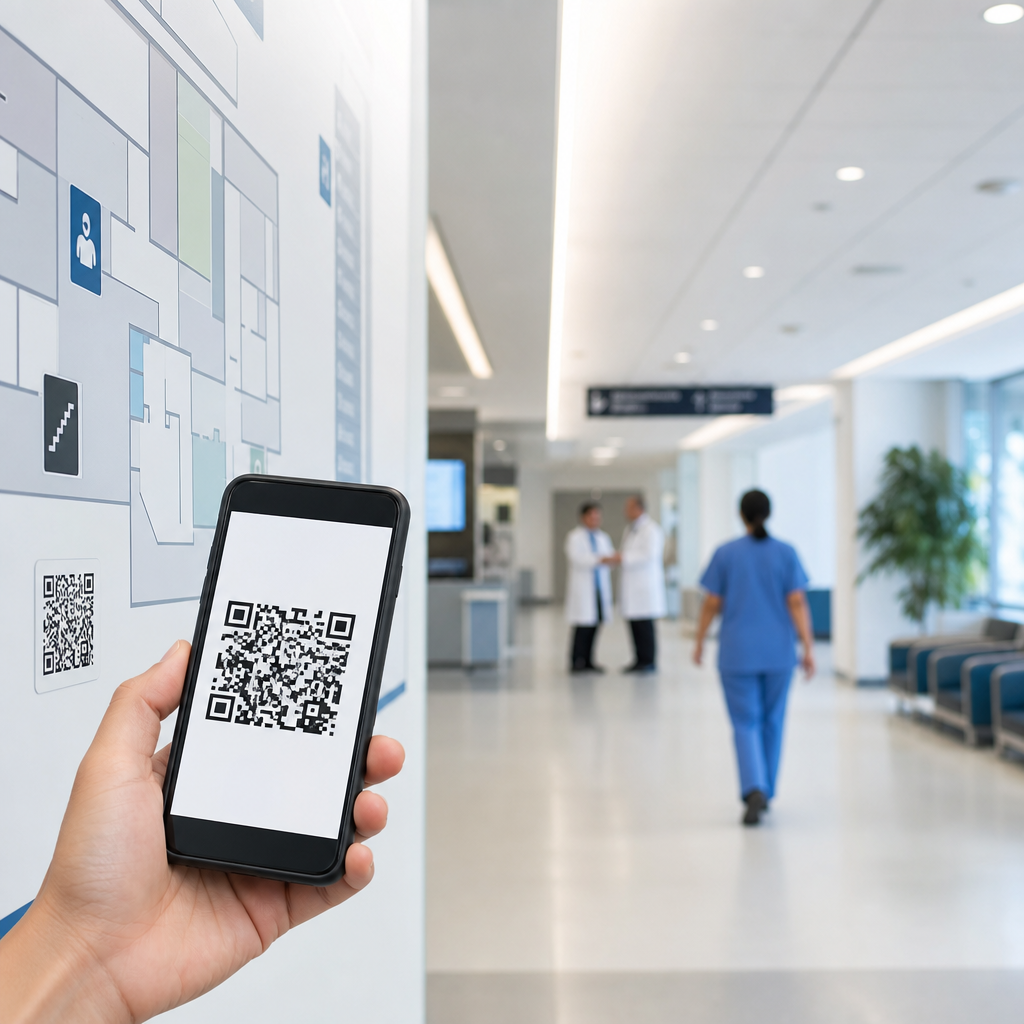
QR codes for hospital navigation and wayfinding solve a costly, frustrating problem: patients, visitors, and even staff routinely get lost in large healthcare campuses, wasting time, missing appointments, and increasing pressure on front-desk teams. In this context, a QR code is a scannable image that opens digital content on a smartphone, while hospital wayfinding refers to the systems that help people move from entrances and parking areas to clinics, labs, imaging suites, pharmacies, and inpatient units. When these tools are combined, hospitals can deliver step-by-step directions, multilingual instructions, campus maps, accessibility guidance, and department updates without forcing users to download an app. I have worked on wayfinding rollouts where a simple scan at the parking garage reduced directional questions at reception within weeks, mainly because people could orient themselves before entering the building. For healthcare organizations, this matters because navigation affects patient satisfaction, on-time arrivals, throughput, and operational efficiency. It also supports broader healthcare communication goals, making this article a practical hub for QR codes in healthcare settings, from outpatient clinics to multi-building academic medical centers.
How QR codes improve hospital navigation at every touchpoint
Hospital navigation breaks down at predictable points: parking, entrances, elevator banks, department transitions, and final room location. QR codes work best when placed exactly at those decision moments. A code at a parking lot can open the correct pedestrian route to the cardiology entrance. A code inside the main lobby can ask, in plain language, “Where are you trying to go?” and then launch a mobile map to oncology, radiology, or the emergency department. A code near elevators can filter directions by floor, clinic name, or room number, which is critical in hospitals where departments move during renovations or service line expansions.
The major advantage is flexibility. Static printed signs are expensive to replace and often become inaccurate after clinic relocations. Dynamic QR codes can be updated centrally while the printed sign stays in place. If mammography moves from the second floor to the fourth floor, the destination link changes without reprinting hundreds of assets. In practice, this reduces maintenance costs and shortens response time during temporary disruptions such as construction detours, elevator outages, or infection-control routing changes.
QR codes also support accessibility more effectively than wall signage alone. A mobile destination page can offer larger text, screen-reader compatibility, contrast options, language selection, and routes that prioritize elevators over stairs. For hearing-impaired users, visual instructions reduce dependence on verbal directions. For patients under stress, especially before surgery or imaging, step-based prompts are easier to follow than memorizing spoken guidance from a registration clerk.
Use cases across healthcare facilities and service lines
Different healthcare environments need different wayfinding strategies, and QR codes adapt well across them. In emergency departments, codes should not replace urgent triage signage, but they can guide family members to waiting rooms, restrooms, charging stations, and patient services. In outpatient settings, they can connect appointment reminders with arrival instructions, parking details, check-in desks, and post-visit pickup points. In inpatient towers, they help visitors navigate to specific units, cafeterias, chapels, gift shops, and discharge pickup zones.
Large academic medical centers gain particular value because their campuses often include specialty pavilions, skybridges, garages, and off-site clinics. A single hospital map is rarely enough. QR codes can direct users into segmented experiences: cancer center navigation, labor and delivery arrival, imaging pre-registration, or pharmacy pickup. Rehabilitation hospitals can include routes optimized for wheelchairs and walkers. Pediatric hospitals often add family-friendly visual cues and landmark-based directions, such as “turn left at the aquarium wall,” improving comprehension for stressed caregivers.
These navigation systems also connect naturally to related healthcare communication workflows. A code can lead not only to directions but also to clinic preparation instructions, visitor policies, digital forms, valet hours, and after-hours entry guidance. That makes a navigation hub more useful than a map alone and positions this healthcare page as a parent topic for deeper articles on patient intake, facility signage, discharge instructions, accessibility, and appointment reminders.
Implementation strategy: signage placement, content design, and governance
Successful hospital QR code wayfinding starts with an audit. Map every point where people pause and ask for help. In my experience, the highest-yield spots are parking payment stations, shuttle stops, entry vestibules, information desks, elevator lobbies, and major corridor intersections. Each sign should answer one immediate question and lead to one clear next action. Overloaded signs fail because users scanning under stress want quick certainty, not a menu of twenty options.
Content design matters as much as sign placement. The landing page should open fast on mobile data, require no login, and present destinations in plain language rather than internal department terminology. “Heart clinic” performs better than “ambulatory cardiovascular services” for many users. The best hospital wayfinding pages also include a search field, a one-tap “use my location” option if indoor positioning is available, and clear fallback text if signal strength is weak. For accuracy, route data should connect to a facilities management process so changes in room assignments or clinic moves trigger content updates immediately.
Governance is essential because hospital environments change constantly. Assign ownership across facilities, marketing, patient experience, IT, compliance, and clinical operations. Establish a change-control workflow for new destinations, retired clinics, construction alerts, and emergency rerouting. Use dynamic QR platforms that support expiration controls, analytics, role-based permissions, and integration with mapping systems or content management tools. Common enterprise options include Bitly for link management, Flowcode for campaign analytics, and specialized digital wayfinding platforms that support indoor maps and kiosk coordination.
Metrics, technology options, and compliance considerations
Hospitals should measure QR code navigation with operational and patient-centered metrics, not scan counts alone. The most useful indicators are appointment lateness linked to wayfinding confusion, front-desk directional inquiries, shuttle or valet bottlenecks, visitor complaints, and patient satisfaction comments mentioning navigation. If a code near garage B gets heavy use but users still miss appointments, the problem may be route clarity rather than awareness. Heatmaps, path completion rates, and destination search logs reveal where people get stuck.
| Decision area | Recommended approach | Why it works in hospitals |
|---|---|---|
| Code type | Dynamic QR codes | Routes and destinations change frequently during renovations or service updates |
| Destination format | Mobile web pages, not mandatory apps | Visitors and first-time patients need instant access without downloads |
| Placement | Decision points such as garages, lobbies, elevators | Users scan when uncertainty peaks, improving adoption and reducing staff interruptions |
| Accessibility | WCAG-aligned pages with large text and screen-reader support | Healthcare audiences include older adults and users with disabilities |
| Measurement | Scans plus lateness, inquiry volume, and satisfaction data | Operational impact matters more than vanity metrics |
Compliance deserves careful attention. A navigation QR code usually does not need to collect protected health information, and that is the safest design choice. Keep destination pages informational unless there is a clear business need for forms or authenticated services. If any workflow collects patient data, evaluate privacy, security, consent, and vendor agreements. Also consider infection prevention and physical durability: signs should be easy to clean, mounted at readable height, and printed with sufficient contrast and quiet-zone spacing to maintain scan reliability under fluorescent lighting.
Common mistakes and best practices for long-term success
The most common mistake is treating QR codes as a cosmetic add-on rather than part of a full wayfinding system. A code cannot fix confusing department names, inconsistent signage hierarchies, or poor campus planning. It should complement physical signs, staffed information points, ADA-compliant routes, and digital directories. Another mistake is sending every scan to a generic homepage. Users need context-specific results: the maternity entrance code should open maternity directions, not the hospital’s top-level website.
Hospitals also underperform when they ignore staff training. Registration teams, volunteers, security officers, and transport staff should know where codes are placed and how to explain them in one sentence. “Scan this for turn-by-turn directions to imaging” is better than “You can use our QR experience.” Branding should be clear but secondary to utility. Include a short instruction line, a plain destination label, and reassurance that no app is required.
Long-term success comes from iteration. Review analytics monthly, test codes on older phones, validate routes with wheelchair users, and run spot checks after any facilities change. Hospitals that do this well create a dependable digital navigation layer that reduces stress, protects schedules, and improves the patient journey from parking space to point of care. As a hub topic within healthcare, QR codes for hospital navigation connect directly to adjacent applications such as appointment management, visitor communications, digital forms, and service-line education.
QR codes for hospital navigation and wayfinding work because they meet patients and visitors at the exact moment confusion occurs and replace guesswork with immediate, mobile-friendly guidance. The strongest programs combine physical signage, dynamic code management, accessible design, accurate routing data, and clear governance. They are especially valuable in healthcare because missed turns translate into missed appointments, delayed care, crowded information desks, and avoidable stress. Hospitals do not need a massive custom app to improve navigation; they need reliable digital directions delivered through well-placed codes and maintained through disciplined operational processes.
For healthcare leaders, the practical takeaway is simple: start with the highest-friction journey, usually parking to check-in, and build from there. Audit where people get lost, deploy dynamic QR codes at key decision points, write plain-language destination pages, and measure outcomes that matter, including lateness, inquiry volume, and patient feedback. Then expand the system across clinics, inpatient units, pharmacies, and visitor services. Done well, this approach strengthens the entire healthcare experience and creates a scalable hub for broader QR code use cases across the organization. If you are planning a healthcare QR strategy, begin with navigation first and use it as the foundation for every patient communication workflow that follows.
Frequently Asked Questions
How do QR codes improve hospital navigation and wayfinding?
QR codes make hospital navigation faster, simpler, and more accurate by turning a printed sign, wall decal, appointment reminder, parking pass, or kiosk display into a direct link to step-by-step digital directions. In a large hospital or multi-building healthcare campus, people often struggle to find the right entrance, elevator bank, registration desk, outpatient clinic, imaging suite, pharmacy, laboratory, or inpatient unit. A QR code helps remove that confusion by opening a mobile-friendly map or wayfinding page on the user’s smartphone without requiring them to search manually.
This matters because hospitals are high-stress environments. Patients may be arriving for time-sensitive appointments, visitors may be unfamiliar with the campus, and staff may need to move quickly between departments. When people get lost, the impact is bigger than simple inconvenience. Delays can cause missed appointments, late check-ins, scheduling disruptions, and increased demand on reception and security teams who must stop what they are doing to provide directions. QR codes reduce that friction by giving users instant access to precise location information exactly where they need it.
They also support a better user experience than static signs alone. Traditional signage is important, but it cannot easily provide personalized routes, alternate paths, language options, accessibility guidance, or live updates. A QR code can link to directions from a specific starting point, identify the nearest entrance for a department, show walking times, and guide users around temporary closures or construction zones. In practice, that means hospitals can create a more flexible and responsive wayfinding system that improves patient satisfaction while reducing operational strain.
Where should hospitals place QR codes for the best wayfinding results?
The most effective QR code placements are at the decision points where people typically become unsure about where to go next. That includes parking garages, surface lots, shuttle stops, main entrances, emergency department entrances, lobby areas, elevator banks, hallway intersections, registration desks, waiting areas, and outside major destinations such as cardiology, radiology, oncology, laboratories, pharmacies, and inpatient towers. Placing QR codes at these transition points helps users confirm that they are on the correct path before they continue deeper into the facility.
Hospitals should also think beyond physical signs inside the building. QR codes can be included in appointment confirmations, pre-visit emails, text messages, mailed letters, discharge paperwork, visitor guides, and event materials. When a patient scans before arriving, they can access directions to the correct building, parking area, entrance, and check-in location. This is especially valuable on campuses with multiple specialty centers, similar building names, or separate entrances for outpatient and inpatient services.
For best results, each QR code should be highly specific. Rather than linking every sign to a generic hospital homepage, it is better to connect each code to the exact destination or route relevant to that location. For example, a code in a parking garage might open “Directions from Garage B to Imaging Check-In,” while a code in the main lobby might offer a menu of popular destinations. The surrounding signage should clearly explain what users will get when they scan, such as “Scan for walking directions to the lab” or “Scan for accessible route to Women’s Health.” Clear labeling improves scan rates and reduces hesitation.
Visibility and usability matter too. QR codes should be printed at a size that is easy to scan, positioned at a comfortable height, well lit, and not obstructed by reflections or cluttered graphics. In a hospital setting, durable materials are also important, especially in high-traffic or frequently cleaned areas. Thoughtful placement turns QR codes from a novelty into a practical extension of the hospital’s navigation system.
Can QR codes support accessibility and multilingual hospital wayfinding?
Yes, and this is one of their most important advantages. Hospitals serve people with different mobility needs, language preferences, vision limitations, and comfort levels with unfamiliar environments. A QR code can link users to digital wayfinding content that is much more adaptable than a printed sign. Instead of offering only one fixed set of instructions, the hospital can provide route options for wheelchair users, elevator-only access, step-free paths, hearing-friendly check-in information, and directions that account for accessible parking or drop-off points.
For multilingual support, QR codes can open landing pages that automatically detect device language or allow users to choose from several language options. This helps non-native speakers navigate to clinics, testing areas, or inpatient units with more confidence. In healthcare, that clarity is especially important because confusion can create missed appointments, elevated anxiety, and poor overall patient experience. A well-designed multilingual wayfinding page can include simple text directions, icons, maps, and even short instructional videos to make navigation easier.
Accessibility can also be improved through mobile features. Users may zoom in on maps, use screen readers, listen to spoken directions, or follow high-contrast visual layouts that are easier to read than some physical signs. Hospitals should ensure that the pages connected to QR codes are built with accessibility standards in mind, including readable fonts, strong color contrast, descriptive labels, keyboard-friendly controls where applicable, and compatibility with assistive technologies.
That said, QR codes should support accessibility, not replace other wayfinding tools. Hospitals still need clear physical signage, staffed information points, and accommodations for people who do not use smartphones. The strongest approach is a layered wayfinding strategy in which QR codes expand access to personalized, inclusive navigation while traditional systems remain available for everyone.
What kind of information should a hospital wayfinding QR code link to?
A hospital wayfinding QR code should link to information that helps a person move confidently from their current location to a specific destination with as little uncertainty as possible. At a minimum, that usually includes the destination name, building, floor, suite or department number, and a clear route map. It should also include practical navigation details such as the best entrance to use, nearby parking options, walking distance, elevator instructions, and expected time to reach the location. The more tailored the information is to the user’s situation, the more effective the QR code will be.
Many hospitals benefit from adding operational details alongside directions. For example, a wayfinding page can include department hours, check-in instructions, whether the patient needs to register first, what to bring, and where family members should wait. For visitors, the page may show visiting hours, approved entry points, and nearby amenities such as cafés, restrooms, gift shops, or ATMs. For staff, internal QR codes can link to back-of-house routes, restricted access workflows, or temporary relocation notices during renovations.
Dynamic content is another major advantage. Because the QR code links to digital content, the hospital can update directions without replacing every printed sign. If a clinic moves, a hallway closes, an elevator is out of service, or a construction detour is needed, the linked page can be revised in real time. This is far more efficient than relying only on static signage, which can quickly become outdated in a busy healthcare environment.
Hospitals can also enhance the experience with features like “start navigation,” shareable directions for caregivers, indoor map overlays, landmark-based instructions, and contact buttons for assistance. The key is to keep the destination experience focused and user-centered. A QR code should not dump users onto a complex website menu and expect them to figure out the rest. It should deliver fast, relevant guidance that answers the immediate question: “How do I get where I need to go?”
How can hospitals measure the success of QR codes for navigation and wayfinding?
Hospitals can measure success by looking at both digital engagement metrics and real-world operational outcomes. On the digital side, they can track scan volume, time of day, repeat scans, device type, language selection, and which locations or destinations generate the most activity. These insights show where people need the most help and which parts of the campus may be causing confusion. For example, if one parking area produces a high number of scans for the same clinic, that may indicate signage gaps or a recurring navigation problem that should be addressed.
Operationally, hospitals should monitor whether QR-enabled wayfinding reduces front-desk direction requests, call volume related to location questions, late arrivals, missed appointments, and patient complaints about finding departments. Staff feedback is especially valuable because reception teams, volunteers, transport personnel, and security officers often see navigation problems firsthand. If those teams report fewer interruptions and smoother traffic flow after QR code deployment, that is a strong sign the system is delivering value.
Patient and visitor satisfaction data can also provide meaningful evidence. Hospitals may include questions in post-visit surveys asking whether it was easy to find the correct building, entrance, or department and whether digital directions were helpful. Combining survey feedback with scan analytics creates a fuller picture of performance. High scan rates alone do not guarantee success; what matters is whether users actually reach their destination more easily and with less stress.
Over time, hospitals can use this data to improve the wayfinding system continuously. They may refine code placement, simplify landing pages, add more destination-specific routes, improve multilingual support, or update accessibility features. In other words, QR codes are not just a navigation tool; they are also a source of actionable insight. When implemented strategically, they help healthcare organizations reduce inefficiency, improve the arrival experience, and make large, complex campuses feel much easier to navigate.