QR codes for appointment scheduling in healthcare solve a simple but costly problem: too much friction between a patient deciding to book care and actually completing the appointment. A QR code, or Quick Response code, is a scannable two-dimensional barcode that opens a digital destination such as a scheduling page, intake form, telehealth room, or patient portal. In healthcare, that destination must do more than load quickly. It must fit clinical workflows, support privacy obligations, reduce no-shows, and work for patients with very different levels of digital confidence. When I have implemented scheduling campaigns for clinics and specialty groups, the best results came from treating the QR code as a front door to access, not a novelty on a poster. Used well, it shortens the path from outreach to booking, improves conversion from offline materials, and gives operations teams measurable data on what channels generate appointments. For hospitals, urgent care networks, dental practices, imaging centers, and community health programs, that makes QR-enabled scheduling both a patient access tool and a revenue protection tool.
The reason this matters is straightforward. Healthcare scheduling is still fragmented across phone lines, referral queues, portals, and front-desk paperwork. Patients abandon bookings when they hit long hold times, complex menu trees, or websites that are hard to navigate on mobile devices. At the same time, providers face pressure to keep calendars full, balance capacity by location and clinician, and document communication in compliant systems. QR codes bridge physical and digital touchpoints: a discharge sheet can send a patient to a follow-up booking page, a vaccine flyer can route to same-day availability, and a waiting room sign can direct family members to preventive care scheduling without tying up staff. The technology itself is inexpensive, but the implementation details determine whether it increases access or creates confusion. The most effective healthcare QR code strategy aligns the code, landing page, scheduling rules, analytics, and patient communication into one reliable booking experience.
How QR codes improve healthcare appointment scheduling
QR codes improve healthcare appointment scheduling by removing steps between intent and action. Instead of asking patients to remember a phone number, search for a clinic online, create an account, and locate the right service line, the scan opens directly to the correct booking path. That matters because every extra click lowers completion rates. In primary care, a code on after-visit summaries can direct patients to annual wellness scheduling. In orthopedics, a code on physical therapy instructions can route patients to follow-up appointments by body region or provider. In dentistry, a recall postcard with a code can open a prefilled hygiene scheduling page. In each case, the patient starts from a physical object and lands on a mobile-ready action page designed for one task.
This approach also supports operational goals. Dynamic QR codes can be edited without reprinting the code itself, so a hospital can change the destination from one scheduling template to another when clinics move, clinicians leave, or seasonal campaigns shift. Marketing teams can track scans by source, such as direct mail, lobby signage, referral packets, or event materials, then compare them to completed bookings in the scheduling system. Access teams can create separate destinations for service lines with different triage needs. For example, dermatology cosmetic consults may go straight to online scheduling, while suspicious lesion visits route first to a symptom-based intake form reviewed by staff. The code is only the trigger; the workflow behind it determines safety, efficiency, and patient satisfaction.
Where healthcare organizations use scheduling QR codes
Healthcare organizations use appointment scheduling QR codes across the care journey. High-performing use cases usually share one trait: they appear where the patient already expects the next step. Discharge paperwork is one of the strongest examples because the patient has a defined follow-up need. A code can open a scheduling page for post-operative checks, medication reviews, or lab follow-ups. Referral management is another strong fit. Specialists can place codes on referral cards or digital PDFs that take patients directly to the new patient scheduling workflow, reducing leakage between referral and first visit.
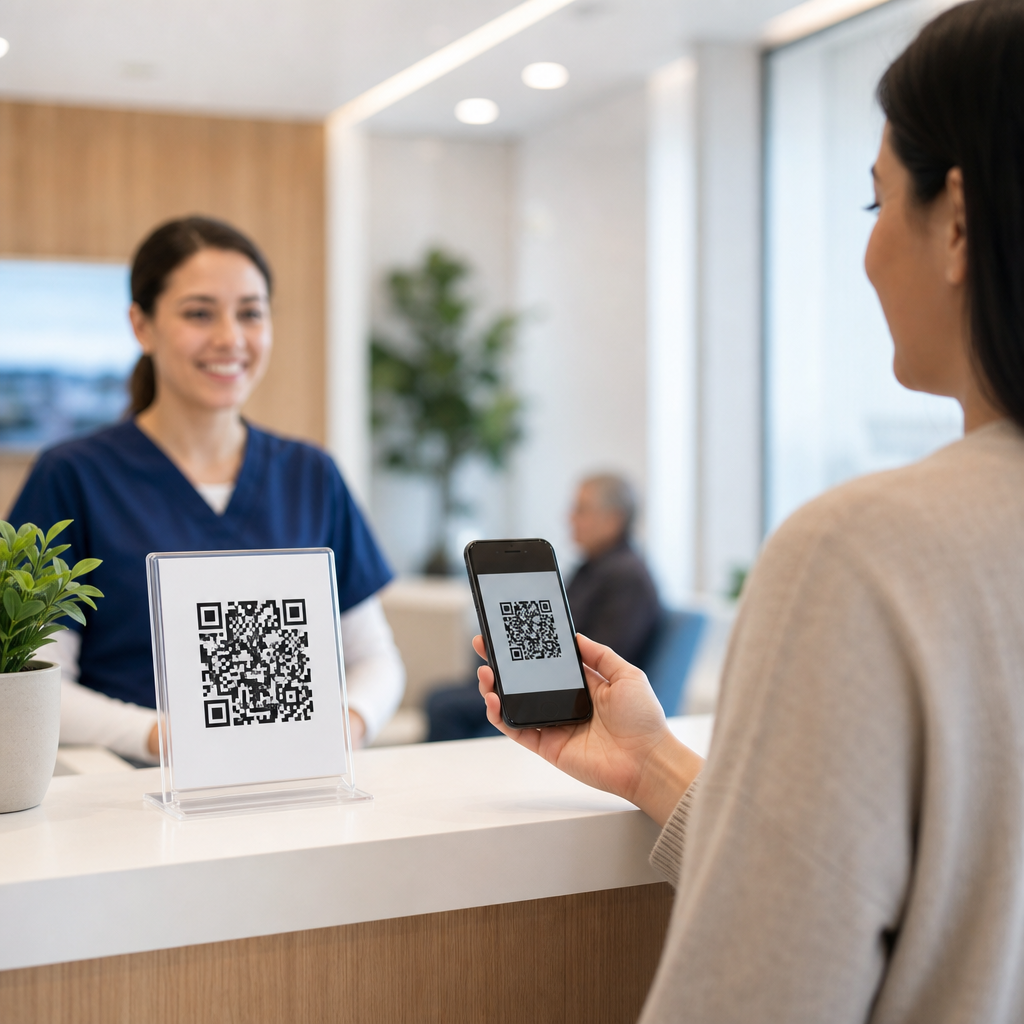
Preventive care and population health outreach benefit as well. Pediatric practices use codes on school physical reminders. Women’s health clinics place them on mammography awareness materials. Community health organizations add them to multilingual flyers for immunizations, prenatal visits, and chronic disease screenings. Urgent care groups often use QR codes outside clinics to let patients book same-day slots or join a virtual queue before entering. Behavioral health providers can place them on brochures in primary care offices to lower the barrier to intake. Even inside facilities, codes on elevator clings or exam room posters can promote follow-up care, portal activation, or family scheduling for related services.
| Healthcare setting | Common QR placement | Scheduling destination | Main operational benefit |
|---|---|---|---|
| Primary care | After-visit summary | Annual wellness or follow-up booking page | Higher recall completion |
| Hospital outpatient | Discharge packet | Post-discharge follow-up scheduler | Reduced care gaps |
| Urgent care | Exterior signage | Same-day slot or queue page | Lower front-desk congestion |
| Dental practice | Recall postcard | Hygiene appointment page | Better reactivation rates |
| Imaging center | Referral handout | Modality-specific scheduler | Faster referral conversion |
Implementation best practices for compliant, high-converting workflows
Successful implementation starts with destination design, not code design. The landing page must match the patient’s context exactly. If the flyer says “Book your flu shot,” the scan should open directly to flu shot availability by location, not a generic home page. Mobile performance is nonnegotiable because most scans happen on smartphones. Use large tap targets, minimal fields, clear insurance instructions, and obvious next steps. If self-scheduling is not appropriate for every appointment type, build a decision tree that routes the patient to online booking, callback request, referral upload, or nurse triage based on service line rules.
Privacy and security require equal attention. A QR code itself does not store protected health information, but the linked system may. That means appointment pages should use HTTPS, role-based access where needed, and vendor agreements that fit healthcare compliance requirements. Avoid printing personally identifiable data into the code. If a clinic uses personalized mailers, point each code to a secure tokenized workflow rather than embedding patient details. I also recommend documenting ownership clearly: marketing may manage print assets, but access operations should own scheduling logic, and compliance should review workflows that collect health information.
Measurement should connect scans to actual outcomes. Common metrics include scan rate, landing page conversion, booking completion rate, no-show rate by source, and downstream visit value. Tools such as Google Analytics 4, campaign-tagged URLs, call tracking platforms, customer data platforms, and scheduling software reports help tie engagement to appointments. For enterprise health systems, link campaign IDs to CRM records or referral management systems so teams can see which departments benefit most. Testing matters. Compare code placement, call-to-action wording, and destination page layouts. Small changes, such as “Scan to book your follow-up” versus “Learn more,” often produce large differences in completed appointments because the patient understands the outcome immediately.
Common challenges and how to avoid them
The most common mistake is sending every scan to one generic scheduling portal. Patients then face service menus, account prompts, and location searches that recreate the original friction. A second mistake is assuming every patient wants full self-scheduling. Many do, but some need reassurance, interpreter support, transportation guidance, or insurance clarification before booking. For those patients, the better workflow may be a code that opens a callback request, text conversation, or staffed navigation form. Accessibility also matters. Printed materials should pair the code with a plain-language URL and a phone number, because some patients do not scan codes or have older devices.
Another challenge is workflow drift over time. Clinics change hours, providers rotate, and templates fill. If no one maintains destinations, codes lead to outdated pages or unavailable slots. Dynamic QR management prevents reprinting costs, but only if organizations establish a review process. I have seen campaigns fail simply because the code worked technically while the booking template behind it had expired. There are also trust concerns. Patients are more likely to scan a code when branding is clear, the action is specific, and the page opens on the organization’s recognized domain. Explain what will happen after the scan, especially in public settings where people may worry about scams or data collection. Credibility increases conversion.
Building a healthcare hub strategy around QR-enabled scheduling
As a hub topic, healthcare should organize QR code scheduling by care setting, patient journey stage, and service complexity. That means creating connected resources for primary care, specialty referrals, urgent care, hospitals, dental, behavioral health, imaging, telehealth, and community outreach. Each subtopic should answer the same practical questions: where the code appears, which appointments can be self-scheduled, what compliance controls apply, which metrics matter, and how staff handle exceptions. This structure helps readers compare implementations while signaling subject depth across the broader industry-specific applications section.
A strong hub also links scheduling to adjacent healthcare workflows. QR codes often support registration, pre-visit forms, medication refill requests, wayfinding, bill pay, patient education, and post-visit surveys. Those functions should not compete with scheduling; they should reinforce it. For example, a post-discharge page can offer follow-up booking first, then directions, preparation instructions, and portal support. An imaging referral page can collect the order, confirm modality prerequisites, and present open slots only after eligibility checks. When organizations design these touchpoints as one connected access system, QR codes become durable infrastructure rather than isolated campaign assets.
QR codes for appointment scheduling in healthcare work because they meet patients where decisions happen and remove avoidable barriers to care. They turn brochures, discharge papers, posters, postcards, and signage into measurable entry points for booking. The biggest gains come from precise routing, mobile-first landing pages, clear governance, and analytics tied to actual appointments rather than scans alone. Healthcare organizations that treat the code as part of access operations, not just marketing, see better follow-up completion, lower scheduling friction, and stronger conversion from offline outreach.
For teams building a healthcare QR strategy, start with one high-value workflow: post-discharge follow-ups, preventive care recalls, or same-day urgent care scheduling. Map the patient journey, define who can self-schedule, publish a simple destination page, and measure completion rates by source. Then expand by service line with the same standards for privacy, usability, and maintenance. Done carefully, QR-enabled scheduling improves access for patients and efficiency for staff. Use this hub as the foundation for your healthcare rollout, then build deeper playbooks for each setting and specialty.
Frequently Asked Questions
How do QR codes improve appointment scheduling in healthcare?
QR codes reduce the number of steps between a patient deciding to seek care and actually booking the appointment. Instead of asking patients to type in a long web address, search for the right clinic page, remember portal credentials, or call during office hours, a simple scan takes them directly to the correct scheduling destination. That might be an online booking page, a specialty-specific intake form, a telehealth check-in link, or a patient portal workflow designed for appointment requests. In practical terms, this lowers abandonment rates because every extra click, login screen, or navigation decision creates friction that can stop a patient from completing the process.
In healthcare settings, that convenience matters because delays in scheduling often translate into missed preventive care, slower follow-up, and lower patient satisfaction. QR codes can be placed on discharge paperwork, recall postcards, prescription handouts, signage, billing inserts, and text message follow-ups, making it easier for patients to act at the exact moment they are ready. They also support clinical operations by directing patients to the right service line instead of a generic homepage. When implemented well, QR codes can improve access, increase completed bookings, reduce call center volume, and help patients move through the care journey with less confusion and less effort.
Where can healthcare organizations use QR codes for appointment scheduling?
Healthcare organizations can use QR codes anywhere patients naturally encounter information and may be ready to take action. Common use cases include waiting room posters, front desk signage, discharge summaries, after-visit summaries, referral packets, prescription bags, appointment reminder cards, direct mail campaigns, and community outreach materials. A primary care practice might use a QR code on a flu shot campaign flyer that links directly to vaccine appointment slots. A specialty clinic might place a code on post-procedure instructions so patients can easily book a follow-up visit. Hospitals may include codes in discharge materials that lead patients to transition-of-care scheduling pages, which can help reduce care gaps after release.
Digital channels can also benefit from QR code workflows. Practices often place them in emails, patient education PDFs, event signage, and presentation materials where patients may be viewing content on a separate device. In multi-location systems, different QR codes can route patients to different facilities, departments, or provider groups without forcing them to navigate a large website. The best placement strategy depends on patient behavior and operational goals. The key is to present the QR code in moments where intent is already high and the next step is obvious, such as “Scan to schedule your annual exam” or “Scan to book your follow-up within 7 days.”
Are QR codes for healthcare appointment scheduling secure and HIPAA compliant?
QR codes themselves do not store protected health information in most implementations, but the destination they open and the surrounding workflow must be designed with security and privacy in mind. A QR code is simply a bridge to a digital action. Compliance depends on what happens after the scan. If the code directs patients to a secure scheduling platform, patient portal, or form that uses encryption, access controls, session protections, and appropriate data handling practices, it can absolutely be part of a HIPAA-conscious workflow. If it leads to an unsecured page collecting sensitive data without proper safeguards, then the convenience creates risk.
Healthcare organizations should treat QR code scheduling as part of their broader digital compliance program. That means using secure HTTPS destinations, minimizing unnecessary data collection, confirming that vendors handling patient information can support required compliance obligations, and making sure any forms or booking tools align with internal privacy policies. It is also wise to avoid printing sensitive patient details directly near personalized QR codes unless there is a clear operational need and a secure process. In addition, organizations should regularly test links, monitor for redirect issues, and use trusted code generation and campaign management tools. Done correctly, QR-based scheduling can be both efficient and responsible, giving patients a faster path to care without compromising privacy standards.
What should a healthcare appointment scheduling page include after a patient scans a QR code?
The landing experience after a scan is just as important as the QR code itself. A good healthcare scheduling page should load quickly, work well on mobile devices, and make the next action immediately clear. Patients should be able to identify the provider, clinic, service type, or purpose of the visit without guessing. If the page is too generic, patients may become uncertain that they are in the right place and abandon the process. Strong pages include plain-language instructions, visible contact options, appointment type explanations, and a streamlined path to available time slots. If the workflow requires a portal login, that requirement should be stated upfront so patients are not surprised midway through the process.
The page should also fit the underlying clinical workflow. For example, new patients may need insurance information, referral details, or intake forms before confirming a visit, while existing patients may only need to choose a time. Telehealth scheduling may require device-readiness instructions, and urgent same-day care may need a triage step before booking. Accessibility also matters: readable text, large tap targets, language support, and compatibility with assistive technologies can improve completion rates across diverse patient populations. Ultimately, the best QR code experience does not just send patients somewhere quickly; it sends them to a page built for clarity, trust, and successful appointment completion.
How can healthcare providers measure the success of QR codes for appointment scheduling?
Success should be measured beyond simple scan counts. While the number of scans can indicate interest, the more important metrics are connected to patient action and operational impact. Healthcare providers should track conversion rates from scan to completed appointment, drop-off points in the scheduling flow, device type, time of day, location-specific performance, and differences across campaign materials. For example, a QR code on a recall postcard may perform differently from one on discharge paperwork, and a code tied to mammography scheduling may convert differently than one used for primary care wellness visits. These insights help organizations understand not only whether people are scanning, but whether the workflow is truly removing friction.
Providers should also evaluate downstream outcomes. Useful indicators include reduced inbound scheduling calls, shorter staff handling time, better follow-up compliance, improved fill rates for available slots, lower no-show rates when QR codes are paired with reminders, and faster scheduling after referrals or discharge. In larger systems, unique QR codes can be assigned to departments, campaigns, or physical materials so performance can be compared accurately. The most mature programs use QR code data to refine messaging, landing pages, and workflow design over time. When measurement is tied to access, efficiency, and patient completion rather than novelty, QR codes become a practical scheduling tool with clear business and care-delivery value.