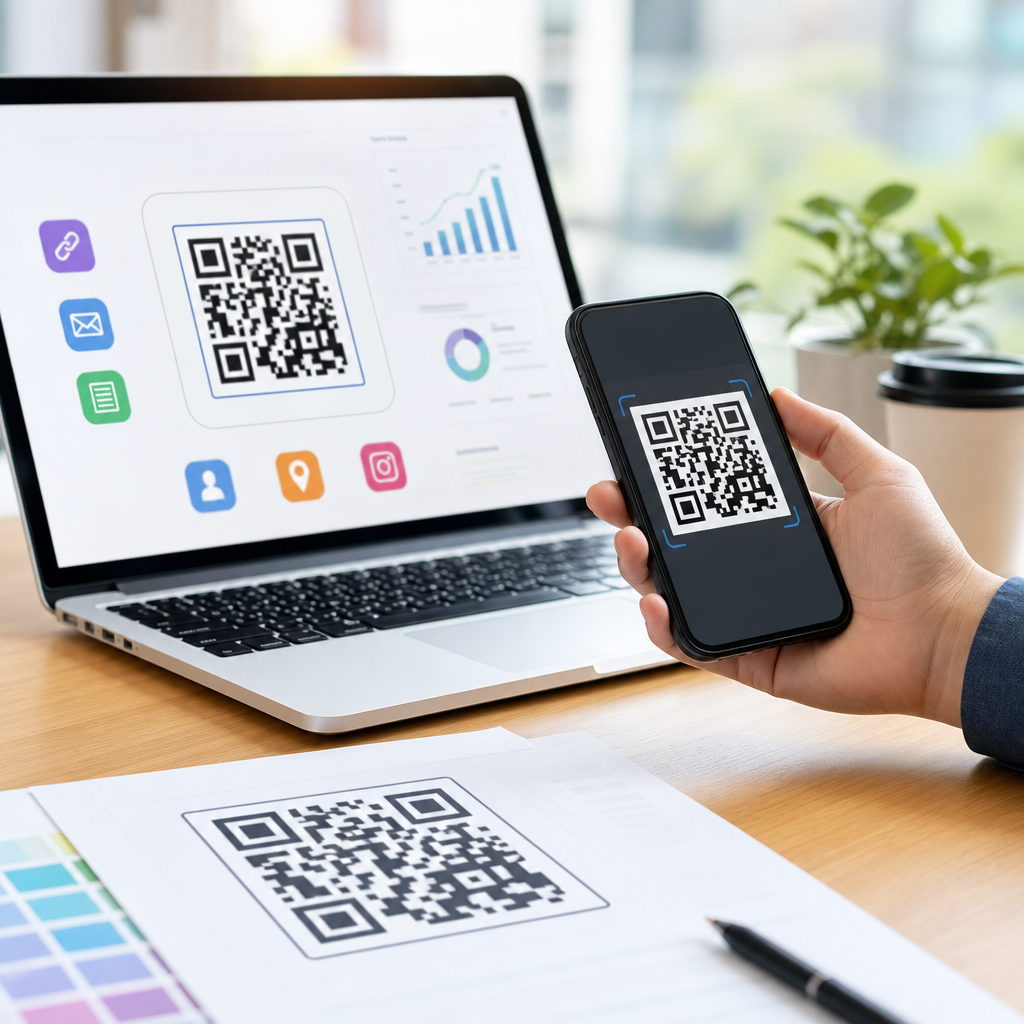

Choosing between PNG and SVG QR codes affects scan reliability, print quality, file handling, and long-term design flexibility. In practical mobile campaigns, I have seen strong offers underperform simply because the wrong file type was exported for the surface where the code appeared. A QR code is a machine-readable matrix of dark and light modules, and its format determines how those modules are stored, scaled, edited, and reproduced. PNG is a raster image built from pixels. SVG is a vector file built from mathematically defined shapes. That technical difference drives everything from sharpness on packaging to ease of branding in a design system.
This topic matters because QR codes now sit across posters, menus, product labels, app download pages, kiosks, direct mail, and in-store signage. Mobile scanning conditions are rarely ideal: low light, curved surfaces, motion blur, reflective coatings, and distance all reduce tolerance for poor rendering. The best format depends on output context, not personal preference. If you manage creating mobile QR codes, this page serves as the hub for QR code formats and file types by explaining where PNG works best, where SVG clearly wins, how file type affects scanning, and what production teams should check before publishing. Used correctly, both can be excellent. Used carelessly, either can fail.
What PNG and SVG QR Codes Actually Are
PNG stands for Portable Network Graphics. It stores an image as a fixed grid of pixels, so a 600 by 600 QR code contains exactly that many picture elements. PNG supports lossless compression, which is why it is far better than JPEG for QR codes. JPEG introduces compression artifacts around hard edges, and those artifacts can interfere with scanners interpreting module boundaries. When teams ask me for a “high-resolution QR,” they usually mean a PNG exported at sufficient dimensions for the intended use. For email, landing pages, and many app screens, that is often enough.
SVG stands for Scalable Vector Graphics. Instead of pixels, it describes shapes with coordinates, paths, and fills. A QR code saved as SVG can scale from a small coupon insert to a trade show backdrop without becoming blurry because the edges are recalculated mathematically at render time. Designers also value SVG because it remains editable in tools such as Adobe Illustrator, Figma, Inkscape, and Sketch. If a brand team wants to adjust padding, recolor modules, add a frame, or align the code within a reusable component library, SVG is usually the more efficient master asset.
For QR code formats and file types, the key distinction is simple: PNG is output-specific, while SVG is production-flexible. That does not mean SVG is always superior. Some platforms rasterize uploaded artwork anyway, some office tools handle PNG more predictably, and some front-end implementations require extra care with inline SVG rendering, caching, and accessibility labeling. The right choice comes from how the code will be displayed, who will edit it, and how often the asset will be repurposed.
Scan Performance: Does File Type Affect Reliability?
File type does not change the encoded QR data, error correction level, or destination URL. It changes how accurately the code’s geometry survives real-world reproduction. In scanning terms, what matters most is edge clarity, adequate quiet zone, contrast, size, and distortion control. A well-prepared PNG can scan perfectly. A poorly exported SVG can fail if a renderer clips the quiet zone or applies styling that rounds corners excessively. I have audited campaigns where the “vector version” scanned worse than the PNG because someone embedded it in a layout that introduced masks and transparency effects.
For on-screen use, PNG performs reliably when exported at the exact pixel dimensions needed for the device context. If a website displays a 256-pixel QR code, serving a crisp 512-pixel PNG for high-density screens usually works well. Problems appear when a tiny PNG is stretched in CSS, inserted into a presentation, or reused in print beyond its native dimensions. The scanner reads jagged transitions as uncertainty. SVG avoids that particular risk because it scales cleanly, making it more forgiving across unknown screen sizes and print outputs.
Quiet zone is a common failure point regardless of format. ISO/IEC 18004, the core QR code standard, defines the symbol structure and reinforces the need for sufficient clear space around the code. In plain terms, scanners need an unbroken margin so they can distinguish the code from surrounding graphics. I recommend maintaining at least four modules of quiet zone, often more in busy layouts. Whether you use PNG or SVG, preserving that margin matters more than adding decorative gradients or logos.
Best Use Cases for PNG QR Codes
PNG QR codes are usually the practical choice for quick digital deployment. If you are adding a code to an email footer, a mobile landing page, a social post, a customer support article, or a marketplace listing, PNG is widely supported and easy to place. Content management systems, slide tools, office software, and marketing platforms all accept it without complaint. Teams working fast often benefit from that compatibility. A restaurant posting a temporary QR code for a seasonal menu on Instagram Stories does not need a vector workflow; it needs a clean raster export at the right size.
PNG is also suitable when the final dimensions are known and unlikely to change. For example, a payment QR code inside a mobile app screen can be exported for the exact component size in the interface library. Likewise, a help center article that consistently uses a 300-pixel code does not require SVG unless brand customization or future scaling is expected. In those cases, PNG reduces complexity and can load predictably through standard image pipelines, CDNs, and caching policies.
The limitation is reuse. Once a PNG asset starts traveling between teams, it often gets copied into documents, enlarged for print, screenshotted, compressed by messaging apps, or pasted into design files without source control. That is where degradation begins. If you know the QR code will move beyond its original context, PNG should be treated as a derivative export, not the master file.
Best Use Cases for SVG QR Codes
SVG QR codes are the strongest option for print, brand systems, and multi-channel asset management. If the same code might appear on product packaging, point-of-sale signage, direct mail, window decals, instruction manuals, and booth graphics, SVG gives production teams one master that scales cleanly everywhere. I rely on SVG whenever a campaign crosses departments because it reduces the risk of someone enlarging a low-resolution raster file at the last minute. Printers, agencies, and in-house designers generally prefer receiving vector artwork for anything that may change size.
SVG is also better for controlled customization. Brands often need a code that fits strict design rules without harming scannability. With a vector file, a designer can fine-tune module color, reposition labels, match spacing, and export derivatives for CMYK print or RGB digital use. This matters in packaging and retail where the code must coexist with dielines, legal text, and visual hierarchy. A cosmetics brand, for example, may place one QR code on a tiny carton panel and the same code on an in-store tester display. SVG handles both without quality loss.
There are caveats. Some email clients and low-code platforms do not render SVG consistently. Some ad networks convert assets during upload. Some web teams inline SVG and then accidentally apply CSS that alters fills or dimensions. For those reasons, SVG is best maintained as the source of truth, while PNG versions are exported for channels that demand raster images.
Production Tradeoffs: File Size, Editing, and Workflow
In day-to-day production, format choice often comes down to workflow efficiency rather than theory. PNG files are straightforward, but large raster exports for print can become heavy. SVG files are often compact for simple QR artwork, though actual size varies depending on how the code is generated and whether unnecessary metadata is embedded. More important is editability. A PNG can be cropped and placed, but not meaningfully refined. An SVG can be adjusted, inspected, and repurposed with less friction. That saves time when marketing, design, and print vendors all touch the same asset.
| Factor | PNG | SVG |
|---|---|---|
| Image structure | Raster pixels | Vector paths and shapes |
| Scaling | Loses sharpness when enlarged | Scales without quality loss |
| Best for | Web, email, fixed-size screens | Print, branding, multi-size reuse |
| Editability | Limited | High in design tools |
| Platform compatibility | Near universal | Good, but inconsistent in some channels |
| Common risk | Upscaling a small file | Styling or export changes that affect margins |
For organized teams, the cleanest workflow is to archive a tested SVG master, document the encoded destination, note error correction level, and export channel-specific PNGs from that source. Naming conventions help: include destination, campaign, version, and intended size. QR code formats and file types become manageable when treated like any other design asset library rather than one-off downloads from a generator.
How to Choose the Right Format for Mobile QR Campaigns
Use PNG when the QR code will live in a fixed-size digital placement, the publishing platform prefers standard image uploads, and no significant scaling is expected. Use SVG when the code may be printed, resized, branded, or reused across channels. If you need one default rule for creating mobile QR codes, make SVG the master and PNG the delivery format where required. That approach protects future flexibility without forcing every channel to support vector rendering.
Before launch, test the code in realistic conditions. Scan from iPhone and Android devices, at expected viewing distance, under dim light, and on the actual material if printing is involved. Check whether dark modules remain solid, whether the quiet zone is intact, and whether any logo or frame reduces readability. On glossy packaging, reflections can matter more than file type. On a subway poster, viewing distance may require a larger physical code. On a mobile webpage, load speed and responsive sizing may favor a compact PNG. The strongest teams do not guess; they validate.
PNG versus SVG QR codes is not a debate with a universal winner. PNG is dependable for quick, fixed-dimension digital use. SVG is the better strategic choice for print quality, scalability, and brand-controlled reuse. For anyone managing QR code formats and file types as part of creating mobile QR codes, the smart decision is to match format to environment, preserve quiet zones, avoid lossy compression, and test every final output before release. Start by standardizing an SVG master workflow, then export PNGs only where the channel truly needs them.
Frequently Asked Questions
What is the main difference between PNG and SVG QR codes?
The core difference is how each file type stores the QR code pattern. A PNG is a raster image, which means it is made from a fixed grid of pixels. An SVG is a vector file, which means it stores the QR code as mathematical paths and shapes instead of colored dots. That difference matters because a QR code is not just a visual graphic. It is a machine-readable grid of modules, and the cleaner and more accurately those modules are reproduced, the better the scanning experience tends to be.
With a PNG, the code is exported at a specific size and resolution. If you enlarge it beyond that intended size, the edges of the modules can become soft, blurry, or visibly pixelated. That can reduce scan reliability, especially in print or on large-format surfaces. With an SVG, the code can scale up or down without losing edge definition because the file redraws the shapes mathematically at any size. That makes SVG especially useful when the same QR code may appear on business cards, posters, packaging, signage, or other materials with very different dimensions.
In practical terms, PNG is often simpler for quick digital use, while SVG offers more flexibility for design, resizing, and production. If your project is likely to change sizes, go to print, or require future editing, SVG usually gives you more control. If you just need a fixed-size image for a website, email, or app interface, PNG can still work very well when exported correctly.
Which format is better for print quality and large-scale use?
SVG is usually the stronger choice for print and for anything that may be enlarged. Because it is vector-based, it preserves crisp, hard edges no matter how large the QR code becomes. That is important because scanners rely on high contrast and clean module boundaries. When a QR code is printed on flyers, menus, product packaging, banners, window decals, trade show displays, or billboards, edge sharpness becomes a real performance factor. A vector file helps protect that sharpness throughout the production process.
PNG can work in print, but only if it is exported at a high enough resolution for the final physical size. That means you need to know in advance how large the code will appear and ensure the pixel dimensions are sufficient. Problems happen when a small PNG is stretched in layout software or repurposed later for a bigger application. The code may still look acceptable to the eye from a distance, but the module edges may no longer be precise enough for reliable scanning under real-world conditions such as glare, angled viewing, lower-end smartphone cameras, or inconsistent lighting.
If you expect the QR code to appear in professional print workflows, SVG is generally the safer long-term asset. It gives printers and designers more flexibility, reduces the chance of accidental quality loss, and helps maintain scan consistency across different production sizes. For mission-critical campaigns, especially those tied to paid media or in-store conversion, SVG is often the format that minimizes avoidable reproduction issues.
Are PNG QR codes ever the better option?
Yes. PNG can absolutely be the right choice in many situations. For digital placements where the QR code will appear at a fixed size, PNG is straightforward, widely supported, and easy to use. It works well for websites, presentation slides, email graphics, mobile apps, downloadable assets, and internal documents. Many teams prefer PNG because it drops easily into content management systems, ad platforms, and design tools without requiring special handling.
PNG can also be helpful when you want predictable rendering in environments that do not always handle vector files gracefully. Some platforms flatten, modify, or inconsistently display SVG files, especially in older workflows or restricted publishing systems. In those cases, a properly exported PNG can be the more dependable operational choice. The key is making sure the file is generated at the correct dimensions and not resized in a way that degrades the image.
Another reason to use PNG is simplicity. If the QR code design is finalized, the display size is known, and there is no need for future editing, a high-quality PNG may be more than adequate. The mistake is not using PNG itself. The mistake is using a low-resolution PNG for a context that demands flexibility, enlargement, or print precision. When matched to the right use case, PNG remains a perfectly valid and often efficient format.
How do PNG and SVG affect scan reliability?
Scan reliability is influenced by several factors, including contrast, quiet zone, error correction level, placement, lighting, and size, but file format plays an important supporting role because it affects how accurately the QR code’s modules are reproduced. SVG has an advantage when scaling is involved because the squares remain crisp and geometrically consistent. That helps preserve the structure the scanner expects to interpret.
PNG can scan just as reliably when exported at an appropriate size and resolution for the final use. The issue appears when the image is compressed too aggressively, resized upward, blurred by workflow settings, or placed on surfaces where print or display conditions are less forgiving. Since QR codes are read by software rather than judged purely by aesthetics, even minor visual degradation can matter. A code that looks acceptable to a designer may still introduce friction for actual users trying to scan from a distance or at an angle.
In real campaigns, this is where format choice becomes practical rather than theoretical. A strong offer can underperform if the QR code asset is not suited to the medium. For example, a PNG exported for web use may fail when reused on a printed poster, while an SVG would have scaled cleanly. The safest approach is to choose the format based on the final environment, test scans on actual devices, and avoid any editing or export process that softens the module edges or reduces the quiet zone around the code.
If I want long-term design flexibility, which format should I keep as my master QR code file?
If long-term flexibility matters, SVG is usually the better master file. Because it is vector-based, it can be resized for different applications without quality loss, and it is generally easier to edit within professional design workflows. That makes it ideal for brands, agencies, marketers, and in-house creative teams that may reuse the same QR code across multiple campaigns, dimensions, and production methods over time.
Keeping an SVG master also helps future-proof your asset library. A campaign that starts with social graphics may later extend to print ads, packaging inserts, event signage, retail displays, or direct mail. If your source file is only a small PNG, you may eventually need to regenerate the code or risk using a file that is not suitable for the new format. An SVG master gives you more adaptability and lets you export high-quality PNG versions whenever a raster format is needed for a specific platform.
A practical workflow is to store the SVG as the primary source file and then generate PNG derivatives at the exact sizes required for web, email, ads, or other fixed-dimension uses. That approach combines flexibility with operational convenience. It also reduces the chance of teams grabbing an outdated or undersized raster file and reusing it inappropriately. If a QR code is likely to have a long life across channels, SVG is generally the smartest foundation.