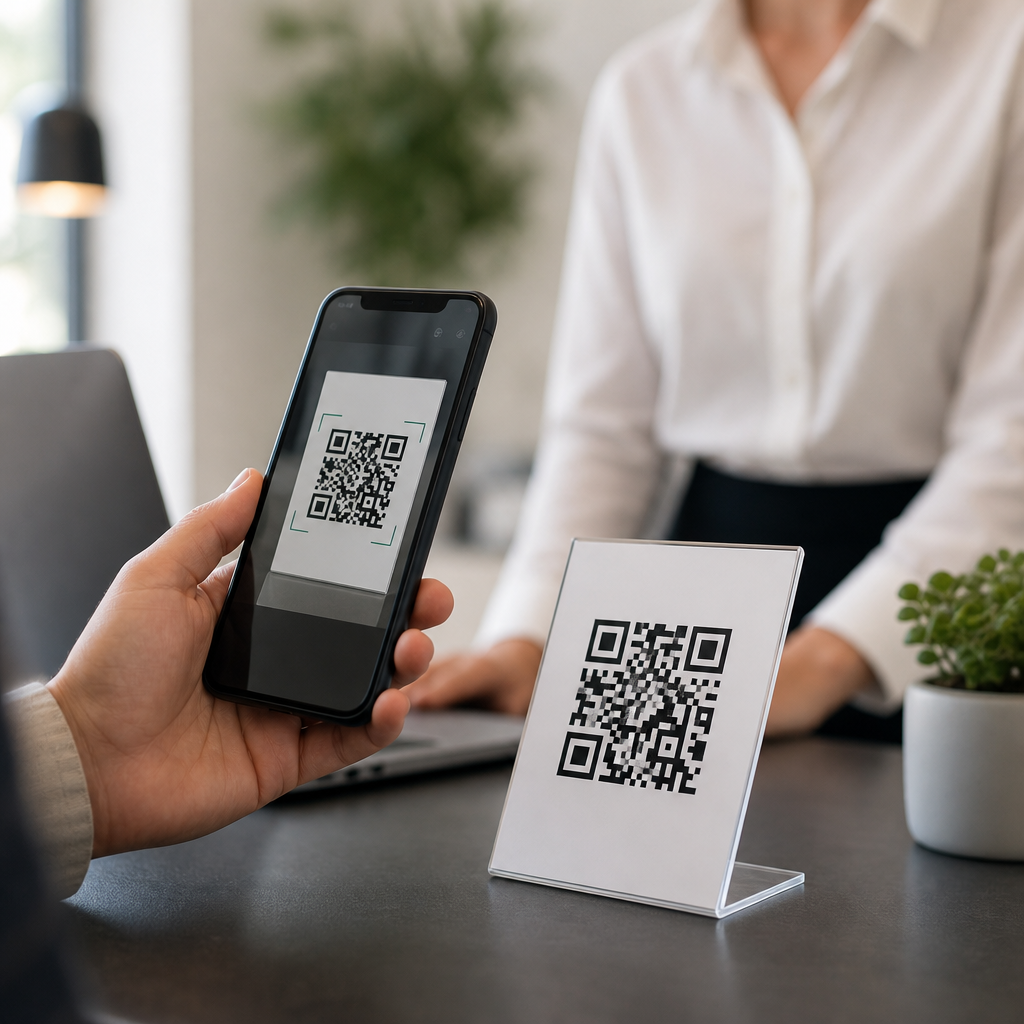

QR codes can last from a few minutes to effectively forever, depending on what type of code you create, how it is printed, where it is displayed, and whether the destination it points to stays available. That simple answer is why the question “How long do QR codes last?” appears so often in general QR code FAQs. People assume the square pattern itself expires. In practice, the black-and-white matrix does not have a built-in timer. What changes is the environment around it: the file hosting, the redirect service, the campaign settings, the paper label, the sunlight, the app scanning it, and the web page or document the code opens.
To understand QR code lifespan, it helps to define two core terms. A static QR code stores the destination directly in the pattern, such as a URL, text string, Wi-Fi credential, vCard, or payment data. A dynamic QR code stores a short redirect URL that sends the scanner to a final destination, which means the destination can usually be changed later inside a QR code generator platform. Static codes generally last as long as the printed or digital image remains readable and the stored content still works. Dynamic codes can last just as long, but only if the provider account, subscription, redirect domain, and linked content remain active.
This matters because QR codes now sit on product packaging, restaurant tables, event tickets, utility bills, posters, business cards, equipment labels, museum exhibits, and industrial assets. I have seen companies print thousands of labels only to learn later that the landing page moved, the redirect account lapsed, or the vinyl sticker faded under UV exposure. A QR code that looks perfect but leads nowhere is functionally dead. So the right question is not only how long QR codes last, but what determines whether they keep scanning successfully over time.
Do QR codes expire? The direct answer
No, QR codes do not inherently expire. A QR code is a machine-readable symbol built on the ISO/IEC 18004 standard. If the modules, finder patterns, timing patterns, and quiet zone remain intact enough for error correction to do its job, a scanner can decode it years later. I have tested static codes printed a decade earlier that still scanned instantly because the print contrast was high and the encoded URL still resolved.
What people call expiration usually means one of four failures. First, the destination disappears, returning a 404 error or dead file. Second, a dynamic QR platform disables the redirect because a free trial ends or billing stops. Third, the physical print degrades through abrasion, moisture, or fading. Fourth, the code was poorly generated or reproduced too small to scan consistently. In every case, the symbol did not “time out”; the surrounding system failed.
For a quick rule, static QR codes can last indefinitely, while dynamic QR codes last as long as the service behind them remains active and maintained. That distinction should guide every purchase, print run, and campaign decision.
What affects how long a QR code lasts?
QR code durability depends on both digital permanence and physical survivability. On the digital side, the main variables are URL stability, redirect reliability, domain ownership, hosting uptime, and file retention. If a brochure QR code links directly to a PDF stored on a website, changing the file path can break the experience. If a code uses a dynamic provider, you must keep the account and redirect rules active. I advise teams to document ownership of domains, generator accounts, and destination files before any broad deployment.
On the physical side, the biggest factors are material, print quality, contrast, size, and placement. A code on laminated packaging stored indoors may remain readable for years. The same design printed on a low-grade paper flyer left in a sunny shop window may fail within months. Outdoor labels need weather-resistant substrates such as polyester or anodized aluminum, UV-stable inks, and adhesives rated for heat and moisture. In warehouses, abrasion from handling often destroys codes faster than sunlight does.
Scan environment also matters. Smartphone cameras are forgiving, but not infinitely so. A code mounted on a curved bottle, printed over a glossy reflection, or placed too high on a sign can seem expired when the real problem is poor scan ergonomics. Good QR longevity planning always includes real-world scan testing across iPhone and Android devices before launch.
Static vs dynamic QR codes: which lasts longer?
Static QR codes usually have the longer practical lifespan because they do not depend on a third-party redirect service. Once generated, the encoded information is fixed. If you print a static URL that you own and keep live, that code can work for many years. Static codes are ideal for evergreen destinations such as a company homepage, a long-term support page, a permanent Wi-Fi network in a managed facility, or a contact card that rarely changes.
Dynamic QR codes offer flexibility rather than automatic longevity. They are best when you need editable destinations, scan analytics, UTM management, A/B testing, geotargeting, or campaign controls. I use them for event registrations, seasonal promotions, restaurant menus, and product packaging that may need a destination update without reprinting. Their weakness is dependency. If the provider shuts down, the account is suspended, or the redirect domain changes, the QR code stops being useful even though the image still scans.
| QR code type | How it works | Main lifespan advantage | Main risk | Best use case |
|---|---|---|---|---|
| Static | Stores final content directly in the symbol | No dependency on a QR platform after creation | Cannot edit destination without reprinting | Permanent pages, fixed contact info, stable documentation |
| Dynamic | Stores a redirect URL managed by a platform | Destination can be updated without replacing the code | Requires active provider, billing, and redirect infrastructure | Campaigns, packaging, menus, asset tracking, analytics |
If you need maximum lifespan, static often wins. If you need control and measurement, dynamic wins, but only with disciplined vendor and account management.
How long do printed QR codes last in the real world?
Printed QR codes can last anywhere from days to decades. The range is wide because the substrate and environment matter more than the symbol design alone. On disposable event badges or shipping labels, the needed lifespan may be only one to seven days. On product manuals, office signage, and retail displays, one to three years is common. On industrial nameplates, utilities infrastructure, or museum plaques, teams often design for five to twenty years.
In field projects, I have found these rough expectations reliable: indoor laser prints on quality paper can stay scannable for years if kept dry and out of direct sun; thermal labels may fade within months depending on heat exposure; solvent, resin, or UV-cured prints on durable materials can last much longer outdoors. For long-term asset tags, direct thermal printing is usually the wrong choice, while thermal transfer with resin ribbon or engraved metal plates performs far better.
Size and contrast are nonnegotiable. A tiny code packed with a long URL becomes fragile because each module shrinks. Standard guidance is to keep strong contrast, preserve the quiet zone, and print large enough for the expected scan distance. As a field rule, the scanning distance is often about ten times the code width. If users will scan from one meter away, a code around ten centimeters wide is a safer starting point.
How to make a QR code last longer
Start with destination planning. Use URLs you control, avoid temporary file paths, and create redirects on your own domain when possible. If you choose a dynamic QR platform, review billing terms, export options, security controls, and what happens if you cancel. The best providers offer custom domains, account roles, and transparent retention policies. For enterprise use, that matters more than a flashy dashboard.
Next, engineer the code for readability. Generate it at an appropriate error correction level, usually M or Q for many print applications, and resist excessive logo overlays that consume data area. Keep the quiet zone clear. Test on multiple devices, under dim light, and at realistic angles. A code that scans only under office conditions is not production-ready.
Then match materials to the environment. For outdoor use, specify UV-resistant inks and weatherproof stock. For chemical exposure, choose labels rated for solvents and abrasion. For equipment, use rigid plates or high-performance polyester. Monitor live deployments too. Periodically scan older placements, check for broken links in analytics tools, and maintain destination pages through normal content governance. Longevity is not a one-time design task; it is an operational process.
Common QR code problems mistaken for expiration
Many failed scans are troubleshooting issues, not true end-of-life. Blurry printing, low contrast, missing quiet zones, warped surfaces, cracked phone screens, weak lighting, and camera focus problems can all block scans. So can app permissions, captive Wi-Fi portals, or corporate firewalls that stop the destination from loading after a successful decode. Users often report, “The QR code expired,” when the actual issue is a broken landing page or poor network connection.
Another common problem is content drift. A business card QR code may still decode, but it opens a profile page with outdated contact details. Packaging may link to a campaign page that was unpublished after a promotion ended. Menu QR codes may point to PDFs renamed during a website redesign. In support teams, I recommend logging these as destination governance failures, because that is how they are fixed.
The simplest habit is scheduled validation. Scan critical QR codes quarterly, test them from current iOS and Android devices, confirm HTTP status responses, and review analytics for sudden drop-offs. This hub article should also lead readers to deeper guides on static versus dynamic codes, QR code size, print best practices, and troubleshooting scan failures. If you manage QR codes as living assets, they will keep delivering value long after launch.
The key takeaway is clear: QR codes themselves do not wear out on a timer, but the content, materials, and systems around them absolutely can. Static QR codes usually offer the longest dependable life because they avoid platform dependency. Dynamic QR codes can also last for years, yet they require ongoing account, domain, and redirect management. In print, lifespan depends on substrate, ink, contrast, size, and exposure to sunlight, moisture, heat, abrasion, and chemicals. In digital use, durability depends on stable URLs, active hosting, and careful content governance.
If you want a QR code to last, think beyond generation. Choose the right code type, print it on materials suited to the environment, preserve scan-friendly design rules, and maintain the destination as seriously as any other customer-facing asset. That approach prevents the most common failures people wrongly describe as expiration. Review your existing QR codes today, test a sample across devices, and update any destinations or labels that put future scans at risk.
Frequently Asked Questions
Do QR codes expire on their own?
No. A QR code does not come with a built-in expiration date. The pattern itself is simply a machine-readable image that stores information, and that image does not suddenly stop working because time has passed. If the code is still clear enough to scan and the information it contains still leads somewhere valid, it can continue working indefinitely. This is why the most accurate answer to “How long do QR codes last?” is that the code itself can last effectively forever, but the real-world conditions around it determine whether it remains useful.
What people often call an “expired” QR code is usually a code that has become unreadable, links to a broken destination, or relies on a service that has been shut off. For example, if a printed code fades in sunlight, gets scratched, or is placed on a curved or reflective surface, scanners may struggle to read it. Likewise, if the QR code points to a web page that is later deleted, moved, or no longer maintained, the scan will technically work but the user experience will fail. In other words, the matrix does not expire on its own; the surrounding infrastructure is what determines longevity.
What is the difference between static and dynamic QR codes when it comes to lifespan?
Static and dynamic QR codes can have very different practical lifespans. A static QR code stores its destination directly in the code itself. If it contains a URL, phone number, email address, or plain text, that information is fixed at the moment the code is created. Because there is no intermediary service required to change or redirect the destination, a static code can last as long as the printed or digital image remains scannable and the stored destination remains active. In many cases, that means a static code can work for years or even indefinitely.
A dynamic QR code usually contains a short redirect URL managed through a QR platform. The main advantage is flexibility: you can update the destination later without changing the printed code. That makes dynamic codes ideal for marketing campaigns, menus, packaging, and any use case where content may need to change. However, their lifespan depends on the continued availability of the service managing the redirect. If the subscription lapses, the provider discontinues the code, or the account is deactivated, the QR code may stop leading users to the intended content. So while dynamic codes can be extremely durable in practice, they are more dependent on account status, hosting, and vendor reliability than static codes are.
How long does a printed QR code last in the real world?
A printed QR code can last anywhere from a few minutes to many years, depending on the printing method, materials, placement, and environmental exposure. Indoors, on quality paper or signage, a QR code may remain easily scannable for a very long time. Outdoors, conditions become more demanding. Sunlight can fade ink, moisture can warp labels, abrasion can damage the pattern, and dirt or glare can interfere with scanning. A QR code placed on a temporary flyer at an event might only need to work for a day, while one printed on product packaging or permanent signage may need to remain readable for months or years.
Durability improves when the code is printed at an appropriate size, uses strong contrast, and is placed on a flat, non-reflective surface. High-quality inks, weather-resistant materials, lamination, UV protection, and professional printing can significantly extend lifespan. It also helps to leave enough quiet zone, or white space, around the code so scanners can detect it properly. If long-term use matters, it is smart to test the code on multiple devices before production and inspect it periodically after installation. A QR code may be theoretically permanent, but in physical settings, wear and exposure are often what determine how long it really lasts.
Can a QR code stop working if the website or file it links to changes?
Yes, and this is one of the most common reasons a QR code appears to “expire.” The QR code may still scan perfectly, but if the destination no longer exists, has been moved, or is blocked, users will not reach the intended content. For example, a code that links to a landing page will become ineffective if that page is deleted or its URL changes without a proper redirect. The same is true for PDFs, videos, image files, booking pages, app download links, and social media profiles. The code remains intact, but the connected resource does not.
This is why destination management matters so much. If you are using a static QR code, the original link should be something stable that you expect to keep active long term. If you are using a dynamic QR code, you can update the destination without replacing the printed asset, which helps preserve the life of the code even when campaigns, offers, or web pages change. Either way, the safest approach is to think beyond the code image itself and plan for long-term content maintenance. A long-lasting QR strategy depends just as much on reliable hosting, redirects, and content management as it does on the design of the code.
How can I make a QR code last as long as possible?
To maximize lifespan, start by choosing the right type of QR code for the job. Use a static QR code when the destination is unlikely to change and you want minimal dependence on third-party services. Use a dynamic QR code when you need flexibility, analytics, or the ability to update the destination later. Next, make sure the destination itself is stable. Keep linked pages live, renew domains on time, maintain hosting, and avoid sending users to temporary or fragile URLs unless the code is meant for short-term use.
On the design and production side, prioritize scan reliability. Use high contrast, keep the code large enough for the viewing distance, and preserve the quiet zone around it. Avoid placing the code on busy backgrounds, curved surfaces, or highly reflective materials. For physical applications, choose durable substrates and printing methods suited to the environment, especially for outdoor or industrial settings. Test the code on different phones, under different lighting conditions, and from realistic scanning distances. Finally, review long-term codes periodically. Even a well-made QR code benefits from occasional checks to confirm that the image is still readable and the destination still works. The longest-lasting QR codes are not just well generated; they are well maintained.