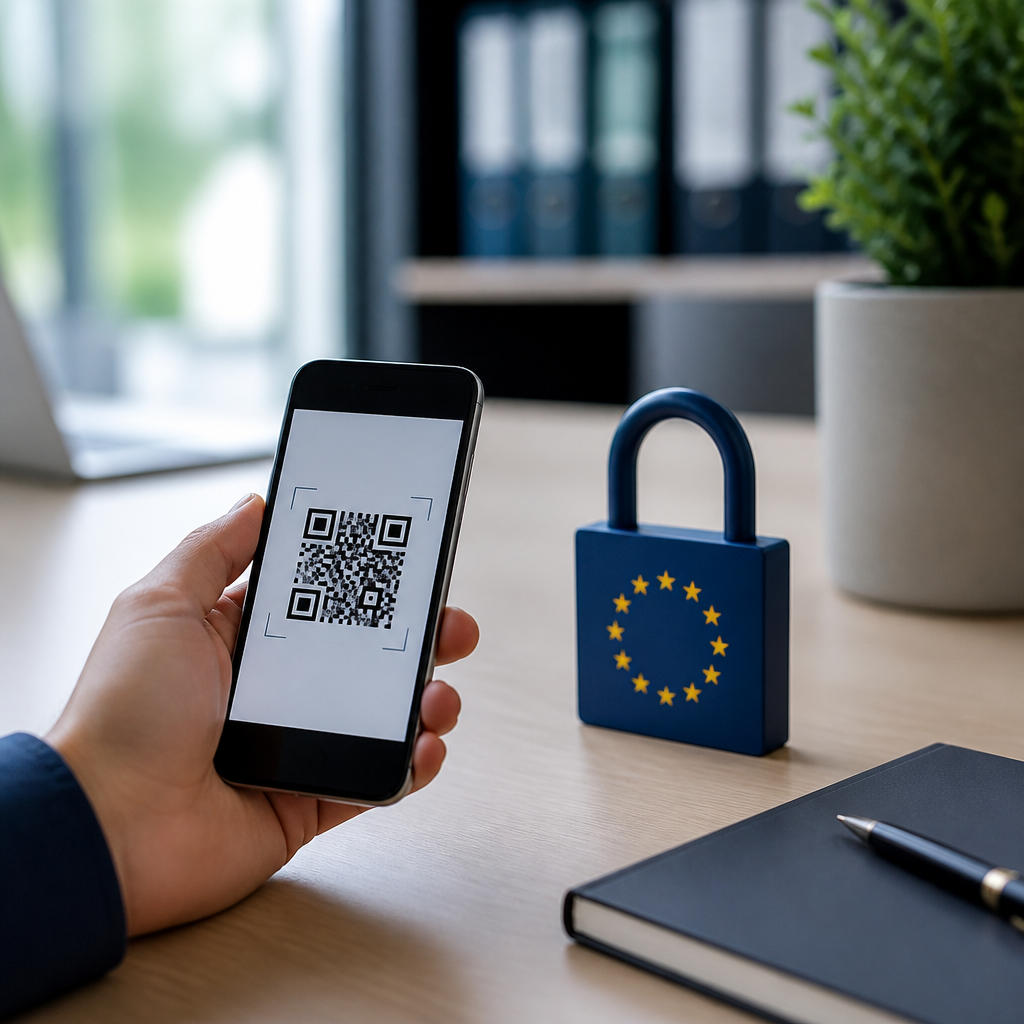
QR codes look simple on the surface, but under European privacy law they can become regulated data collection tools the moment a scan identifies, tracks, profiles, or measures a person. For any business using QR codes in marketing, payments, packaging, events, hospitality, healthcare, or employee operations, understanding GDPR is not optional. It shapes what data you collect, why you collect it, how long you keep it, and what rights the individual keeps after scanning.
GDPR, the General Data Protection Regulation, applies when an organization processes personal data of people in the European Economic Area. Personal data means any information relating to an identified or identifiable person. A QR code itself is not automatically personal data. A static code printed on a poster may simply contain a public URL. The compliance issue begins when the code links to a page with analytics, embeds unique identifiers, triggers app permissions, collects forms, records location, or connects a scan to a customer profile.
I have seen teams assume that because a QR code is just an image, privacy rules sit elsewhere. In practice, regulators look at the full processing chain: the code, the landing page, the device interaction, backend logs, marketing tools, and any third party receiving data. That broader view matters because a harmless campaign can turn into personal data processing through UTM parameters, cookie banners, CRM enrichment, or event registration workflows.
This matters for three reasons. First, QR campaigns often bridge offline and online behavior, which makes tracking especially sensitive. Second, they are frequently deployed by nontechnical teams that reuse templates without reviewing lawful basis or notices. Third, QR codes are everywhere now, from restaurant menus to product authentication and patient intake. If your organization uses them at scale, GDPR should be built into campaign design, not bolted on after launch.
When a QR code falls under GDPR
A QR code falls under GDPR when scanning leads to the processing of personal data. Common triggers include personalized URLs, loyalty signups, newsletter forms, event check-ins, Wi-Fi access portals, support requests, digital business cards, and payment flows tied to account data. Even server logs can qualify if they capture IP addresses and timestamps in a way that can be linked back to a person. The key test is not the image itself, but whether the surrounding system can identify someone directly or indirectly.
There is an important distinction between static and dynamic QR codes. Static codes contain fixed content and usually create fewer privacy issues if they link to a public page with no tracking. Dynamic codes route through a management platform before redirecting the user. That platform may record scan time, approximate location, device type, language settings, and referral data. Those metrics can be useful for operations, but they may also create a personal data footprint that must be governed.
Special caution is needed when QR codes are used in workplaces, schools, housing, or healthcare settings. In those contexts, consent may not be freely given because of imbalance of power, and the information collected can reveal sensitive facts. A check-in code at a clinic can imply health status. A code on an employee desk booking system can reveal attendance patterns. A resident portal code on a rent notice can expose financial circumstances. Context changes the compliance analysis.
Lawful basis, transparency, and consent
Every GDPR-compliant QR code workflow needs a lawful basis under Article 6. Consent is one option, but it is not the default answer. If someone scans a code to complete a purchase, contract may apply. If a venue uses a code to distribute a digital menu, legitimate interests may support basic delivery and limited security logging. If a code opens a marketing signup form or enables advertising cookies, consent is usually required before nonessential tracking starts. Choosing the right basis affects notices, retention, and individual rights.
Transparency is where many QR deployments fail. People often scan quickly from physical environments with little surrounding explanation. A poster, table tent, product label, or conference badge should tell users what happens next in plain language: where the code goes, what data is collected, whether analytics or cookies are used, and who controls the processing. The first landing page should continue that explanation through a concise privacy notice layered above the full policy.
Consent, when needed, must be specific, informed, freely given, and unambiguous. A scan alone is not valid consent to everything that follows. If the landing page loads marketing trackers before a user chooses, that undermines compliance. In my audits, the safest pattern is simple: let the code open a clean page, load only essential functions by default, then ask for optional permissions or marketing consent through a compliant banner or form checkbox that is not pre-ticked.
What data QR code systems often collect
Organizations underestimate how much information sits behind a scan. The table below shows common data points, typical uses, and the privacy questions they raise.
| Data point | Typical use | GDPR question |
|---|---|---|
| IP address | Security logging, analytics | Is retention limited and justified? |
| Timestamp | Measure scan volume | Can it identify a person when combined with other data? |
| Approximate location | Campaign performance by region | Is location necessary, and has it been disclosed? |
| Device type and OS | Optimize landing pages | Are you collecting more than you need? |
| Unique URL token | Personalized offers, event entry | Does it link directly to an individual profile? |
| Form submissions | Lead capture, support, registration | What lawful basis supports each field? |
| Cookie identifiers | Retargeting, attribution | Was valid consent obtained before setting them? |
Data minimization should govern every field and every event you log. If your campaign only needs aggregate scan counts by day, do not keep persistent identifiers for months. If a form asks for an email address to send a brochure, do not also require birth date, phone number, and employer unless there is a clear necessity. Purpose limitation matters just as much. Data collected to validate event access should not automatically feed an unrelated marketing audience without a separate legal basis and clear disclosure.
Privacy by design for QR campaigns
Privacy by design means planning the QR experience so compliance is built into the workflow from the start. In practical terms, that begins with mapping the journey from printed code to final database. Identify who generates the code, which redirect service is used, what analytics fire on page load, which vendors receive data, where the data is stored, and when it is deleted. If nobody on the team can draw that flow, the privacy risk is already higher than it should be.
The strongest implementations use separate codes or landing pages for different purposes instead of one code that quietly performs many functions. A product packaging code can lead to instructions without loading advertising trackers. A second clearly labeled code can invite the customer to join a loyalty program. This separation improves transparency and helps keep consent choices meaningful. It also reduces the temptation to treat every scan as a lead generation event.
Technical controls matter too. Use HTTPS on every redirect and destination. Disable unnecessary fingerprinting scripts. Restrict access to QR analytics dashboards through role-based permissions and multifactor authentication. Set retention schedules for raw logs. If a third-party QR management platform acts as a processor, put a data processing agreement in place and review its hosting locations, subprocessors, and security measures. For higher-risk deployments, especially those involving profiling or vulnerable groups, conduct a Data Protection Impact Assessment before launch.
Individual rights, vendors, and international transfers
Once personal data is collected through a QR code flow, the usual GDPR rights apply. People may request access, correction, deletion, restriction, objection, or data portability, depending on the legal basis and context. That means your backend must be able to find data tied to a scan or form submission without unreasonable effort. If your system stores scan records in one dashboard, consent data in another tool, and lead data in a CRM, you need a process for reconciling those records accurately.
Vendor management is equally important because QR campaigns often rely on website builders, analytics suites, customer data platforms, email tools, and event systems. Each vendor needs a defined role: controller, joint controller, or processor. The distinction is not paperwork trivia; it determines who decides the purposes and means of processing. International transfers also need scrutiny. If scan data moves outside the EEA, use approved transfer mechanisms and assess the receiving country and provider safeguards carefully.
For a sub-pillar hub on QR code security, privacy, and compliance, the practical lesson is straightforward. Treat every QR project as a data flow, not a graphic design asset. Start with necessity, document lawful basis, write concise notices, minimize tracking, and vet every vendor in the chain. Done well, QR codes remain useful, measurable, and customer-friendly without creating avoidable privacy risk. Review your current codes, landing pages, and analytics setup now, then update weak spots before the next campaign goes live.
Frequently Asked Questions
1. Are QR codes themselves covered by GDPR?
Not automatically. A QR code, by itself, is simply a machine-readable pattern that stores or points to information. GDPR becomes relevant when scanning that code leads to the collection, use, or disclosure of personal data. That can happen very quickly in practice. For example, if a QR code opens a landing page that records IP addresses, places analytics cookies, tracks location, logs device identifiers, connects the scan to a customer account, or measures an employee’s activity, the business is likely processing personal data under GDPR.
The key legal question is not whether the tool is called a QR code, but whether the scan identifies a person directly or indirectly, or allows a person to be singled out, profiled, or monitored. A static QR code that simply links to a general public webpage may involve limited privacy risk. A dynamic QR code used in a campaign dashboard, loyalty program, event check-in system, patient workflow, or workforce operation can be much more sensitive because it often enables tracking, attribution, and behavioral analysis.
Businesses should therefore treat QR codes as part of a wider processing activity rather than as a harmless graphic. If the scan initiates data collection, analytics, consent management, personalized redirects, payment flows, attendance records, or any other processing involving individuals, GDPR obligations are likely triggered. That means thinking about lawful basis, transparency, data minimization, retention, security, and data subject rights from the start.
2. What kinds of personal data can be collected through a QR code scan?
Many organizations underestimate how much data can be captured when someone scans a QR code. Even if the code does not visibly ask for a name or email address, the surrounding systems may still collect personal data. Common examples include IP addresses, approximate location, browser and device information, referral data, timestamps, cookie identifiers, app identifiers, and interaction history after the scan. If the scan links to a logged-in customer portal, payment page, booking form, employee tool, or healthcare system, the data can become even more directly identifiable.
QR codes can also be used in ways that create strong compliance obligations because they connect a person to a specific action in a specific place and time. A code on event badges may show who attended which session. A restaurant menu scan may be tied to repeat visits or loyalty enrollment. A product packaging code may reveal post-purchase behavior. A workplace QR code might log presence, training completion, or access to internal resources. In healthcare or hospitality settings, a scan may connect to highly sensitive information depending on the purpose and system design.
Under GDPR, personal data is interpreted broadly. It includes not only obvious identifiers like names and email addresses, but also data that can reasonably be linked back to an individual, especially when combined with other records. That is why businesses should map the full data flow behind the QR experience, not just the information visibly requested on screen. If scan data is used to distinguish users, analyze behavior, personalize content, measure engagement, or build profiles, it should be treated as personal data processing and governed accordingly.
3. Do businesses need consent to use QR codes under GDPR?
Not always, but many businesses assume too quickly that consent is either unnecessary or sufficient on its own. GDPR requires a valid lawful basis for processing personal data, and consent is only one of several options. Depending on the use case, a business may rely on contract, legal obligation, legitimate interests, or, in some contexts, consent. The right lawful basis depends on what happens after the scan and why the data is being processed.
For example, if a customer scans a QR code to access a digital receipt they requested, some processing may be necessary to provide that service. If a guest scans a code merely to view a menu, the business should ask whether extensive tracking is really necessary. If a QR code launches analytics, ad-tech, or behavioral profiling tools, consent may be required, especially where cookies or similar tracking technologies are involved under ePrivacy rules alongside GDPR. If sensitive personal data is involved, such as health-related information, the compliance threshold is much higher and a separate Article 9 condition may be required.
Consent, where used, must be freely given, specific, informed, and unambiguous. That means no hidden tracking behind a scan, no vague notices, and no pre-ticked boxes. Individuals should understand what data will be collected, for what purpose, and with whom it will be shared before or at the time of collection. Businesses should also remember that consent must be as easy to withdraw as it is to give. In short, scanning a QR code is not the same as consenting to unlimited data use. The scan may show interest in a service, but it does not erase the need for a proper lawful basis and clear privacy information.
4. What GDPR information should be provided when someone scans a QR code?
Transparency is one of the most important GDPR requirements in QR-based interactions. People should not have to guess what happens after they scan. At a minimum, businesses should clearly explain who is collecting the data, what categories of data are being collected, why the data is needed, the lawful basis for processing, how long the data will be kept, whether it will be shared with third parties, and what rights the individual has. They should also explain whether scans are tracked for analytics, personalization, fraud prevention, or performance measurement.
In practice, this usually means using a layered privacy approach. The QR code itself may sit on packaging, signage, receipts, tables, badges, posters, or internal materials where space is limited. That is fine, but the first page after scanning should provide immediate and accessible notice, with links to a fuller privacy policy where appropriate. If the business uses cookies or similar technologies, the user may also need a compliant consent mechanism before non-essential tracking begins. For high-risk uses, such as employee monitoring or health-related processing, businesses should be especially explicit and avoid burying key information in general website policies.
Good transparency is not just about legal protection; it is also about trust. When people understand why a QR code is there and what data is collected, they are more likely to engage confidently. A short prompt such as “Scan to register for the event — attendance and usage data will be processed as described here” can make a meaningful difference. The main rule is simple: if the scan triggers personal data processing, the individual should receive privacy information in a clear, timely, and understandable format.
5. How can a business use QR codes in a GDPR-compliant way?
The strongest approach is to build privacy into the QR code workflow from the beginning rather than trying to patch compliance in later. Start by defining the exact purpose of the QR code. Is it for payments, product information, event check-in, table ordering, support access, employee operations, or campaign measurement? Once the purpose is clear, collect only the data genuinely needed for that purpose. Avoid adding unnecessary analytics, location tracking, or profiling features just because the technology allows it.
Next, document the processing activity and choose the correct lawful basis. Review whether third-party platforms are involved, such as QR management tools, CRM systems, analytics providers, payment processors, or cloud hosting vendors. If those providers process personal data on your behalf, appropriate data processing agreements may be required. If data leaves the European Economic Area, international transfer rules must also be considered. Businesses should also set retention periods, apply access controls, secure the linked pages and databases, and ensure there is a process for handling requests for access, deletion, objection, or restriction.
It is also wise to assess risk by context. A QR code on a poster linking to a general information page may present minimal privacy concerns. A dynamic code tied to named customers, staff members, patients, or event attendees can be much riskier, especially if it enables tracking over time. In higher-risk cases, a Data Protection Impact Assessment may be appropriate. Finally, test the user journey: what does the person see before and after scanning, what data is captured silently, and can you justify every element of that collection? GDPR compliance with QR codes is ultimately about accountability, necessity, and transparency. If a business can clearly explain what it collects, why it collects it, how it protects it, and how individuals can exercise their rights, it is in a much stronger position legally and operationally.