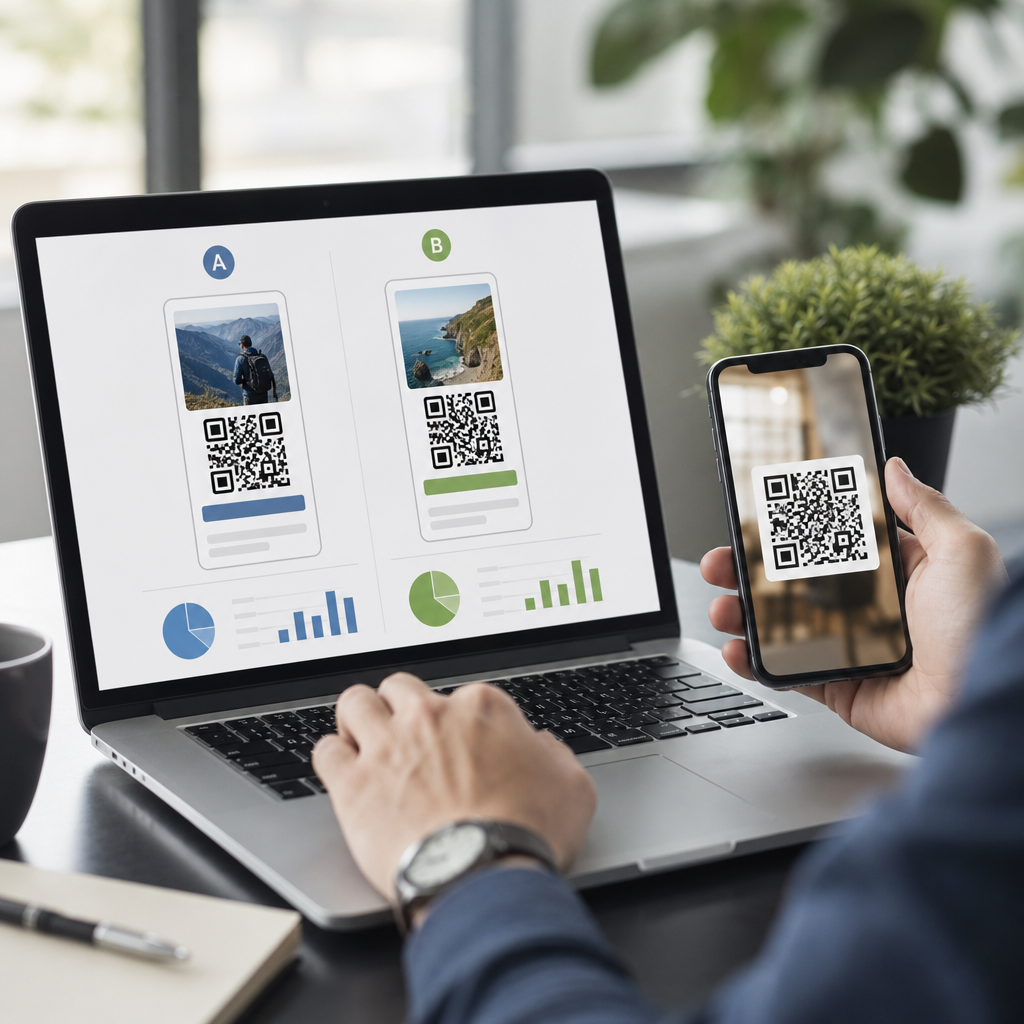
AI-driven QR code personalization strategies turn a simple scan into a context-aware interaction that changes by audience, intent, timing, and behavior. In practice, this means the same QR code can send one customer to a product demo, another to a loyalty offer, and a third to a support flow based on rules or model-driven predictions. For teams building advanced QR code strategies, this matters because static destinations waste attention, while personalized experiences raise conversion rates, improve attribution, and reduce friction across print, packaging, retail, events, and field operations. I have implemented QR programs in campaign environments where the code itself stayed fixed but the post-scan experience adapted continuously using CRM data, geolocation, device type, and engagement history. That shift moves QR from a convenience tool to a measurable orchestration layer. The core components are dynamic QR codes, customer data, automation workflows, decision logic, and analytics. When these elements work together, brands can serve relevant landing pages, trigger follow-up sequences, score intent, and learn which contexts produce revenue. The result is better customer experience and stronger operational efficiency, especially when personalization is designed with privacy controls, testing discipline, and clear business outcomes from the start.
What AI-driven QR code personalization actually includes
AI-driven QR code personalization combines dynamic QR infrastructure with machine learning, predictive segmentation, and workflow automation. A dynamic QR code points to a redirect service rather than a fixed URL, allowing the destination to change without reprinting the code. AI adds decision-making by evaluating signals such as past purchases, email engagement, location, on-site behavior, inventory availability, and time of day. Automation platforms then deliver the next step, whether that is a tailored landing page, a coupon, a support article, or a sales alert inside a CRM.
The most effective programs are built on a few dependable use cases. In retail, packaging QR codes can identify repeat buyers and route them to replenishment offers or usage tutorials. At events, badge or booth QR scans can classify leads by industry and job role, then trigger different follow-up sequences in HubSpot or Salesforce. In restaurants, table QR codes can recommend menu items based on weather, local demand, and prior orders. In field service, equipment QR codes can show technicians different maintenance content depending on asset history and sensor alerts. These are not gimmicks. They reduce search time, improve relevance, and create cleaner first-party data than broad untargeted campaigns.
Teams often ask whether personalization requires a large data science function. Usually, it does not. Many strong deployments begin with rules-based logic inside tools like Zapier, Make, Segment, Klaviyo, or Adobe Journey Optimizer, then layer in model scores later. For example, a business can start by routing new versus returning scanners differently, then add propensity scoring once enough scan and conversion data accumulates. This staged approach lowers risk and speeds implementation.
Data inputs, automation architecture, and decision logic
A reliable personalization stack starts with data collection that is lawful, minimal, and useful. Common inputs include UTM parameters, referrer details, device class, operating system, IP-derived location, scan timestamp, CRM identifiers, loyalty status, product SKU, and prior interactions. If the scan happens after an authenticated email click or app session, the destination can be personalized at the individual level. If identity is unknown, contextual personalization still works well by using geography, campaign source, and aggregate behavioral patterns.
Architecture matters because scan experiences happen in seconds. The redirect layer must be fast, resilient, and capable of passing parameters into downstream systems. In most implementations, the QR code points to a short branded URL managed by a dynamic QR platform. That platform sends scan events to analytics and CDP tools, checks routing logic, and directs the user to a page variant or app deep link. Automation tools can then create or update records, enroll the user in a nurture path, notify sales, or suppress irrelevant messaging. The logic should be explicit: what data is evaluated, which conditions take priority, and what fallback experience appears if data is missing.
| Component | What it does | Common tools | Practical example |
|---|---|---|---|
| Dynamic QR platform | Hosts redirect, updates destination, records scans | Bitly, QR Code Generator PRO, Flowcode | Change a packaging campaign page without reprinting labels |
| Customer data layer | Unifies identifiers and behavioral history | Segment, mParticle, Salesforce Data Cloud | Recognize loyalty members and show member pricing |
| Automation engine | Triggers workflows after scans | Zapier, Make, HubSpot, Marketo | Send a post-event email sequence after a booth scan |
| Decision model | Scores intent or predicts best next action | BigQuery ML, Azure ML, Amazon SageMaker | Route high-propensity prospects to a demo booking page |
| Analytics layer | Measures scans, sessions, conversions, and lift | GA4, Looker Studio, Power BI | Compare packaging scans by region and retailer |
Decision logic should stay interpretable, especially early on. A transparent hierarchy works best: compliance checks first, then identity checks, then campaign context, then predictive ranking. If a user has opted out, do not personalize beyond necessary operations. If the scan comes from a known service customer, prioritize support. If the scan comes from a high-intent prospect near a sales region, surface booking options. This sequence prevents conflicting actions and makes troubleshooting possible.
High-impact personalization strategies for QR campaigns
The best AI-driven QR code personalization strategies align to a concrete business objective. For lead generation, personalize the landing experience by audience segment and buying stage. A QR code on a trade show banner can route executives to ROI calculators, technical buyers to integration documentation, and existing customers to expansion offers. For ecommerce, personalize product education and replenishment. A code on product packaging can show setup videos for first-time buyers, accessories for repeat customers, or warranty registration for users whose purchase date suggests activation. For local marketing, pair QR scans with inventory and store data. A code on direct mail can send users to the nearest in-stock location, not a generic store finder.
In hospitality and restaurants, personalization can increase average order value without creating app friction. I have seen table QR programs perform better when the first screen changes according to daypart, weather, and party context. Lunch visitors may see speed-oriented bundles, while evening visitors see higher-margin add-ons and reservations for future visits. In healthcare and regulated sectors, the strategy is different: use personalization to reduce confusion and route people to the right information, not to over-target. A clinic QR code can identify language preference, location, and appointment type, then present the correct forms and instructions while avoiding unnecessary data exposure.
Subscription businesses benefit from lifecycle-based personalization. A scan from an onboarding insert should not lead to the same destination as a scan from a renewal postcard. New users need setup guidance, feature activation prompts, and support access. Near renewal, the same code family can emphasize usage summaries, plan comparison, and account management. Manufacturers can use serialized QR codes tied to batch, region, and distributor to tailor training materials, verify authenticity, and collect channel intelligence. When linked with ERP and CRM systems, those scans can reveal which partners generate downstream service requests or reorder activity.
Measurement, optimization, and governance
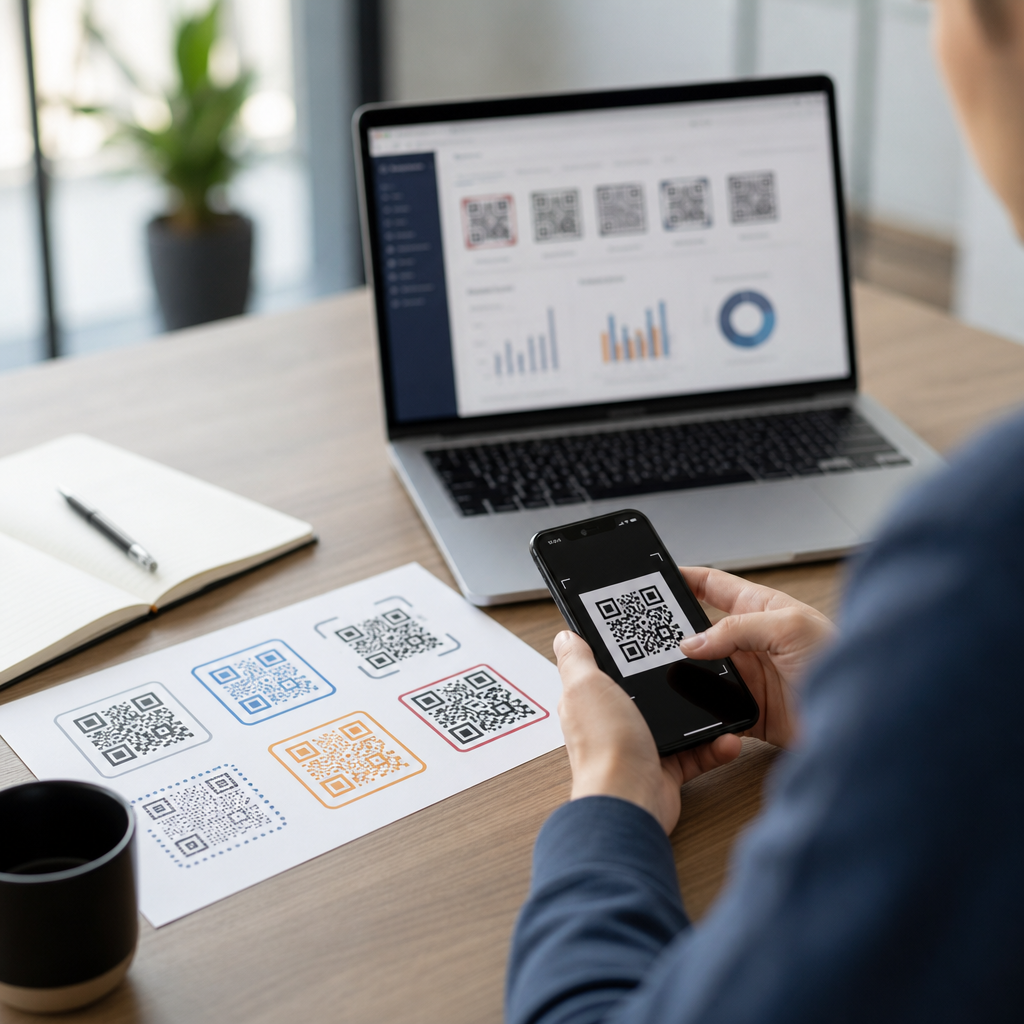
Personalization only works if teams measure outcomes beyond scan volume. The key metrics are scan-to-session rate, bounce rate, dwell time, assisted conversions, direct conversions, average order value, lead qualification rate, and downstream retention. For operational QR use cases, measure time to resolution, self-service completion, technician efficiency, and error reduction. A useful dashboard segments results by source placement, audience, location, and decision path. If one QR code placement performs well in scans but poorly in conversion, the problem is often a mismatch between physical context and landing content rather than the code itself.
Testing should be systematic. Start with controlled experiments comparing a generic destination against a contextual destination. Then test increasingly sophisticated variants, such as rules-based versus model-ranked offers. In many programs, the largest gains come from simple improvements: faster pages, clearer calls to action, and better continuity between the physical surface and the landing page. AI helps most when there are enough choices and enough data to make smarter routing decisions. Without those conditions, complexity can outpace value.
Governance is essential because QR scans often bridge offline and online data. Publish retention rules, consent standards, and access controls. Follow platform and regional requirements, including GDPR and CCPA where applicable. Avoid collecting personal data unless it supports a defined use case. Maintain audit trails for routing logic, especially in healthcare, finance, and enterprise support environments. Also plan for failure states. If the personalization engine is unavailable, the user should still receive a relevant default page, not an error. Strong QR code strategy always includes redirects, monitoring, and content ownership across marketing, analytics, and operations.
Building a scalable hub for QR codes, AI, and automation
As a sub-pillar under advanced QR code strategies, this topic works best as a hub connecting implementation guides, platform comparisons, analytics tutorials, privacy standards, and industry examples. The hub page should define terms clearly, answer common questions quickly, and direct readers to deeper resources on dynamic QR codes, CRM integration, landing page personalization, attribution models, and automation workflows. Internal links should mirror the way teams actually build these systems: choose infrastructure, connect data sources, design decision logic, launch a pilot, measure results, then expand.
The practical advantage of AI-driven QR code personalization strategies is simple: one scan can become the most relevant next step instead of a generic click. Dynamic routing, customer data, and automation let brands improve conversions, service outcomes, and attribution without changing the printed code. Start with a narrow use case, use transparent logic, measure business impact, and add predictive models only after the foundation is reliable. If you manage packaging, events, retail, field service, or lifecycle marketing, audit your current QR journeys and identify where relevance breaks down. Then build a pilot that proves personalization earns its place.
Frequently Asked Questions
What is AI-driven QR code personalization, and how is it different from a standard dynamic QR code?
AI-driven QR code personalization is the practice of using data, rules, and predictive models to change what happens after a scan based on context. Instead of sending every person to the exact same destination, the system evaluates signals such as device type, location, time of day, campaign source, prior engagement, customer segment, purchase history, or likelihood to convert. It then routes the user to the experience most relevant to that moment. That could mean a first-time visitor sees an introductory product video, a returning customer gets a loyalty reward, and a user with a recent support history is directed to troubleshooting resources.
A standard dynamic QR code is more limited. It usually lets you update the destination URL after printing, which is useful, but it does not automatically tailor the experience to different audiences unless you manually build that logic around it. AI adds decision-making at scale. It can continuously optimize destination selection, message sequencing, and content recommendations based on live behavior and historical patterns. In other words, dynamic QR codes make change possible, while AI-driven personalization makes that change intelligent, adaptive, and performance-oriented.
How can businesses use AI to personalize QR code experiences across different audiences and moments?
Businesses can personalize QR code experiences by connecting scan events to audience data and decision logic. A retail brand, for example, might use one printed QR code on packaging and let AI determine whether the scanner should see a reordering page, a new product cross-sell, a limited-time discount, or a care guide. A restaurant could present different menus based on location, weather, or peak hours. A B2B company could route prospects to industry-specific landing pages, demo booking flows, or case studies depending on firmographic data and prior campaign interactions.
The strongest strategies usually combine explicit rules with model-driven predictions. Rules handle clear scenarios, such as sending users in a certain region to the correct language version or directing after-hours scans to self-service support. AI models handle subtler decisions, such as estimating which offer is most likely to convert, which content depth best matches user intent, or when a customer is at risk of dropping off. This approach allows teams to adapt QR journeys by audience, intent, timing, behavior, lifecycle stage, and channel source without creating an unmanageable number of separate codes.
In practice, this works best when the post-scan experience is modular. Instead of one static page, teams build content blocks, offers, calls to action, and routing options that can be assembled dynamically. AI then chooses the most relevant combination. This makes the scan feel less like a generic redirect and more like a context-aware interaction designed for the individual user.
What data signals are most useful for AI-driven QR code personalization?
The most useful signals are the ones that reveal user intent and can be collected responsibly. Common high-value inputs include scan timestamp, geolocation at a broad level, device type, operating system, referral source, campaign ID, product or placement associated with the QR code, and whether the user is new or returning. Behavioral signals are especially powerful, including previous scans, on-site browsing patterns, cart activity, email engagement, purchase history, and support interactions. When available and compliant, CRM and loyalty data can significantly improve relevance because they help distinguish anonymous curiosity from known customer intent.
Contextual signals also matter more than many teams expect. The same person may need a different experience depending on where and when they scan. A code scanned on retail packaging at home may suggest tutorials, refill reminders, or accessory recommendations. That same code scanned in-store may be better used for price comparison, reviews, or instant coupons. Time-sensitive cues such as seasonality, inventory levels, event timing, and local conditions can all improve the quality of the recommendation engine.
That said, better personalization does not always require more data. It requires the right data and clear decision priorities. Many successful programs start with just a handful of inputs, such as audience segment, geography, and prior engagement, then expand as measurement improves. The key is to use signals that genuinely influence the next-best action rather than collecting data for its own sake.
How do you measure the success of an AI-personalized QR code strategy?
Success should be measured across both engagement and business outcomes. At the top of the funnel, teams typically track scan volume, unique scanners, scan-to-landing-page load rate, bounce rate, time on page, click-through rate, and interaction depth. These metrics help confirm whether the personalized destination is relevant enough to hold attention. From there, the focus should shift to conversion metrics such as form submissions, demo bookings, purchases, repeat orders, coupon redemptions, app downloads, support case deflection, or loyalty enrollments, depending on the use case.
Because the goal of personalization is lift, comparison is essential. Businesses should test personalized QR experiences against static destinations or simpler rule-based flows to determine whether AI is producing meaningful improvement. Useful methods include A/B testing, holdout groups, multi-armed bandit optimization, and segment-level performance analysis. The most credible measurement frameworks also look at downstream outcomes, such as average order value, customer retention, support resolution speed, and lifetime value, rather than only immediate clicks.
Operational metrics matter too. Teams should monitor routing accuracy, page load times, model confidence, fallback rates, and data freshness. If the system is making good decisions but the destination loads slowly or key data is delayed, performance will suffer. A mature AI-driven QR program therefore treats personalization as a full optimization loop: collect data, predict intent, deliver the best experience, measure results, and retrain or refine over time.
What are the biggest implementation challenges, and how can companies avoid common mistakes?
The biggest challenges are usually not technical alone. They involve data quality, integration, governance, and experience design. Many companies underestimate how fragmented their customer and campaign data is, which makes it difficult to make accurate personalization decisions at scan time. Others build overly complicated logic before they have validated the core use cases. A common mistake is focusing on the novelty of AI rather than the practical value of the post-scan experience. If the destination does not solve a real user need quickly, even the smartest routing model will underperform.
Another major challenge is privacy and compliance. Personalized QR experiences should be built with transparent data practices, clear consent where required, and sensible limits on data collection and retention. Users should not feel surveilled simply because they scanned a code. Brands that do this well emphasize relevance, speed, and utility while keeping personalization proportional to the context.
To avoid common mistakes, companies should start with a narrow, high-impact use case and a clear success metric. Build a decision framework that includes both AI-driven recommendations and deterministic fallback rules. Keep the destination experience fast, mobile-friendly, and easy to act on. Make sure analytics are in place before launch so you can attribute outcomes correctly. Most importantly, treat the strategy as iterative. The best AI-driven QR code programs improve through ongoing testing, segmentation refinement, creative optimization, and feedback loops between marketing, product, and analytics teams. That disciplined approach is what turns a simple scan into a consistently higher-performing personalized journey.